
Arrange the following compounds in the increasing order of the rate of reaction towards nucleophilic substitution.
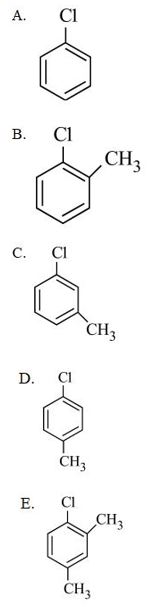
Choose the correct answer from the following options:
Answer & explanation
Correct answer: option 1
The correct answer is option 1. E < D < C < B < A.
In nucleophilic aromatic substitution reactions, the rate can be influenced by the presence and position of substituents on the benzene ring. The key factors are:
Electron-Withdrawing Groups (EWGs): These groups stabilize the negative charge on the intermediate anionic species (like the Meisenheimer complex) formed during the reaction, thus increasing the rate of substitution.
Electron-Donating Groups (EDGs): These groups destabilize the negative charge on the intermediate, making the nucleophilic substitution reaction slower.
Detailed Analysis of Each Compound:
A. Chlorobenzene:
Structure: Benzene ring with a chlorine substituent.

Reactivity: Chlorobenzene is the least reactive towards nucleophilic substitution because chlorine is an electron-withdrawing group but not as strong as other substituents. The resonance stabilization of the chlorine and the strong C-Cl bond make the nucleophilic attack less favorable.
B. 2-Chlorotoluene:
Structure: Benzene ring with a chlorine substituent and a methyl group at the ortho position.

Effect of Methyl Group: The methyl group is an EDG that donates electrons via the inductive effect. This increases the electron density on the ring and makes the carbon bearing the chlorine more reactive towards nucleophiles, although the ortho position does not significantly enhance reactivity compared to the para position.
C. 3-Chlorotoluene:
Structure: Benzene ring with a chlorine substituent and a methyl group at the meta position.

Effect of Methyl Group: The methyl group is less effective at stabilizing the negative charge on the intermediate because it is located at the meta position. It doesn’t have a strong resonance or inductive effect on the ring's chlorinated position.
D. 4-Chlorotoluene:
Structure: Benzene ring with a chlorine substituent and a methyl group at the para position.

Effect of Methyl Group: The para position allows the methyl group to donate electrons via resonance to the ring, increasing the electron density at the site of substitution and making the reaction faster compared to the ortho and meta positions.
E. 2,4-Dichlorotoluene:
Structure: Benzene ring with two chlorine substituents (at ortho and para positions) and a methyl group (at the remaining ortho position).

Effect of Substituents: Both chlorine atoms are strong EWGs, which significantly stabilize the negative charge on the intermediate complex. The methyl group at the ortho position donates electrons via resonance, which, combined with the strong EWGs, results in the highest reactivity towards nucleophilic substitution.
Summary of Reactivity:
2,4-Dichlorotoluene (E) is the most reactive due to the combination of strong EWGs (chlorines) and an EDG (methyl group) enhancing the reaction rate. 4-Chlorotoluene (D) is more reactive than 2-Chlorotoluene (B) due to the favorable position of the methyl group (para). 2-Chlorotoluene (B) is more reactive than 3-Chlorotoluene (C) because of the better electron-donating effect of the ortho-positioned methyl group. 3-Chlorotoluene (C) is less reactive than the others due to the meta position of the methyl group. Chlorobenzene (A) is the least reactive due to the absence of any strong electron-donating effects and the stability provided by the chlorine atom.
So the correct option from the provided choices is 1. E < D < C < B < A