
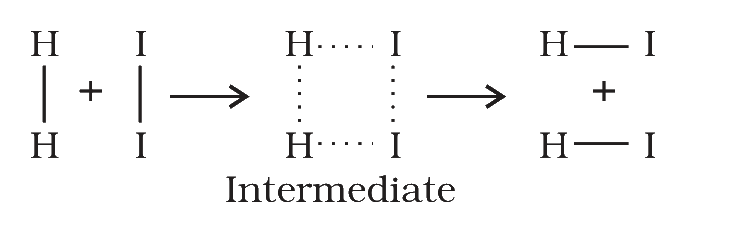
The figure shows how the reaction \( \ce{H2(g) + I2(g) -> 2HI(g)} \) takes place in a single step through an intermediate.
What is the molecularity of this step?
Answer & explanation
Correct answer: option 4
The correct answer is Option (4) → 2 (bimolecular)
Molecularity is the number of reacting species that must collide simultaneously in an elementary reaction.
In the figure, one molecule of H2 and one molecule of I2 come together to form the intermediate. Two species collide, so the step is bimolecular, molecularity 2.
The intermediate contains four atoms, but molecularity counts the colliding species (two molecules), not the atoms.
NCERT (2026-27 edition):
3.2.4 Molecularity of a Reaction – “The number of reacting species (atoms, ions or molecules) taking part in an elementary reaction, which must collide simultaneously in order to bring about a chemical reaction is called molecularity of a reaction.” … “Bimolecular reactions involve simultaneous collision between two species, for example, dissociation of hydrogen iodide.”
3.4 Temperature Dependence of the Rate of a Reaction – “According to Arrhenius, this reaction can take place only when a molecule of hydrogen and a molecule of iodine collide to form an unstable intermediate (Fig. 3.6). It exists for a very short time and then breaks up to form two molecules of hydrogen iodide.”
Fig. 3.6: Formation of HI through the intermediate