Select the relation which correctly relates the variation of \( Λ_m \) with concentration for strong electrolytes.
Answer & explanation
Correct answer: option 2
The correct answer is Option (2) → \(Λ_m=Λ_m^0-Ac^{\frac{1}{2}}\)
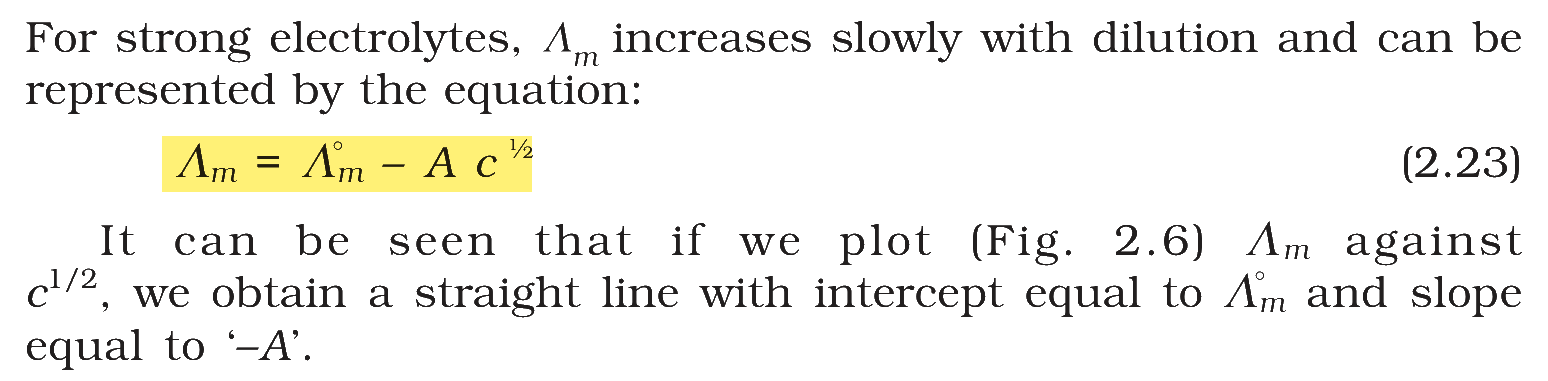
For a strong electrolyte the ions are already completely free at all concentrations. On dilution, the ions move farther apart, the interionic attractions weaken, and each ion moves more freely, so \( \Lambda_m \) increases slowly. The variation is linear in the square root of concentration (the Debye–Hückel–Onsager equation):
\( \displaystyle \Lambda_m = \Lambda^{\circ}_m - A\,c^{1/2} \)
Here \( \Lambda^{\circ}_m \) is the limiting molar conductivity (at infinite dilution) and A is a constant for a given solvent, temperature and type of electrolyte. A plot of \( \Lambda_m \) against \( c^{1/2} \) is a straight line with intercept \( \Lambda^{\circ}_m \) and slope −A.
Why the other options are incorrect
Option (1) \(Λ_m=Λ_m^0-Ac\) — Incorrect. \( \Lambda_m \) falls linearly with \( \sqrt{c} \), not with c.
Option (3) \(Λ_m=Λ_m^0+Ac^{\frac{1}{2}}\) — Incorrect. With a plus sign, \( \Lambda_m \) would rise with concentration; in fact it is highest at infinite dilution.
Option (4) \(Λ_m=Λ_m^0-Ac^{\frac{3}{2}}\) — Incorrect. The power of c is 1/2, as found by experiment and theory, not 3/2.
NCERT (2026-27 edition):
Strong Electrolytes