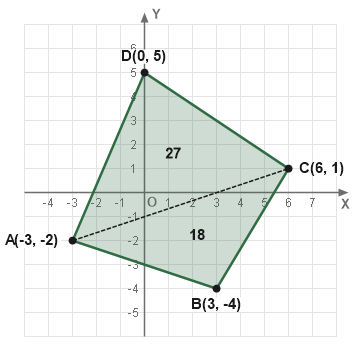
\(A(-3,\,-2)\), \(B(3,\,-4)\), \(C(6,\,1)\) and \(D(0,\,5)\) are the vertices of a quadrilateral ABCD, taken in order. What is the area of the quadrilateral?
Answer & explanation
Correct answer: option 3
The correct answer is Option (3) → 45 square units
The diagonal AC splits the quadrilateral into two triangles, ABC and ACD; their areas, from \(\frac{1}{2}\left|x_1(y_2-y_3)+x_2(y_3-y_1)+x_3(y_1-y_2)\right|\), are added.
Triangle ABC: \(-3(-4-1)+3(1-(-2))+6(-2-(-4))=15+9+12=36\)
Area of ABC \(\displaystyle =\frac{1}{2}\times36=18\) square units
Triangle ACD: \(-3(1-5)+6(5-(-2))+0(-2-1)=12+42+0=54\)
Area of ACD \(\displaystyle =\frac{1}{2}\times54=27\) square units
Area of ABCD \(=18+27=45\) square units