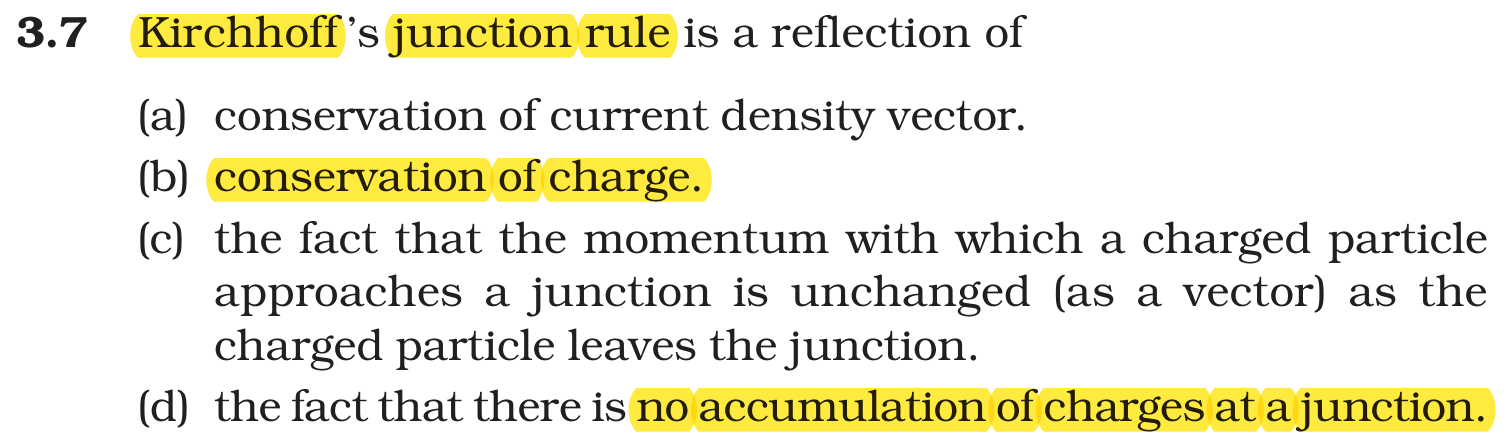
Kirchhoff’s junction rule is based on
(A) conservation of charge
(B) the fact that the momentum with which a charge particle approaches a junction is unchanged as it leaves the junction
(C) conservation of energy
(D) the fact that there is no accumulation of charge at the junction
Choose the correct answer from the options given below:
Answer & explanation
Correct answer: option 4
The correct answer is Option (4) → (A) and (D) only
Kirchhoff’s junction rule says that the sum of currents entering a junction equals the sum leaving it. In steady state no charge piles up at a junction, so this is conservation of charge.
(A) conservation of charge — Correct. Charge flowing in per second equals charge flowing out per second.
(B) the fact that the momentum with which a charge particle approaches a junction is unchanged as it leaves the junction — Incorrect. The rule says nothing about momentum. Charge carriers change direction at a junction, so their momentum is not conserved there.
(C) conservation of energy — Incorrect. Energy conservation is the basis of the loop rule, not the junction rule.
(D) the fact that there is no accumulation of charge at the junction — Correct. This is the steady-state condition that makes charge conservation read “current in = current out”.
NCERT Exemplar:
Current Electricity – …