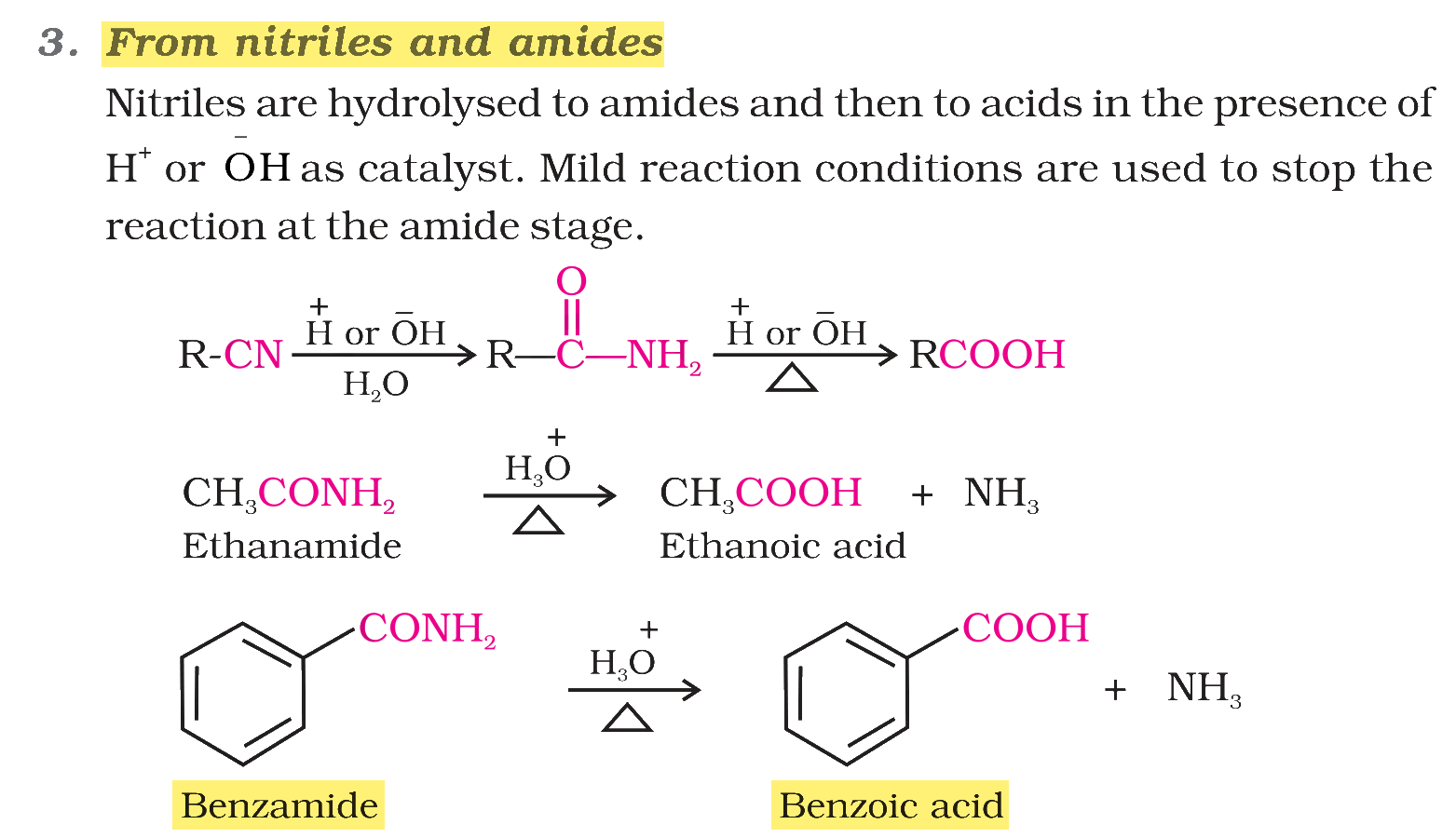
What product is formed when benzamide is heated with dilute acid (H3O+)?
Answer & explanation
Correct answer: option 1
The correct answer is Option (1) → Benzoic acid
An amide is hydrolysed to a carboxylic acid when heated with dilute acid or alkali. The C–N bond breaks: the –NH2 group is replaced by –OH, and nitrogen leaves as ammonia (as \( \ce{NH4^+} \) in acid).
Benzamide gives benzoic acid:
\( \displaystyle \ce{C6H5CONH2 + H3O^+} \xrightarrow{\Delta} \ce{C6H5COOH + NH4^+} \)
Why the other options are incorrect
Option (2) Benzaldehyde — Incorrect. Going from an amide to an aldehyde is a reduction. Hydrolysis only swaps –NH2 for –OH and keeps the carbon at the carboxylic acid level.
Option (3) Benzyl alcohol — Incorrect. \( \ce{C6H5CH2OH} \) needs a reducing agent; for example, benzaldehyde is reduced by \( \ce{NaBH4} \). Dilute acid reduces nothing.
Option (4) Methyl benzoate — Incorrect. This ester forms when benzoic acid is heated with methanol and an acid catalyst; no alcohol is present here:
\( \displaystyle \ce{C6H5COOH + CH3OH} \xrightarrow{\ce{H^+}} \ce{C6H5COOCH3 + H2O} \)
NCERT (2026-27 edition):
8.7 Methods of Preparation of Carboxylic Acids