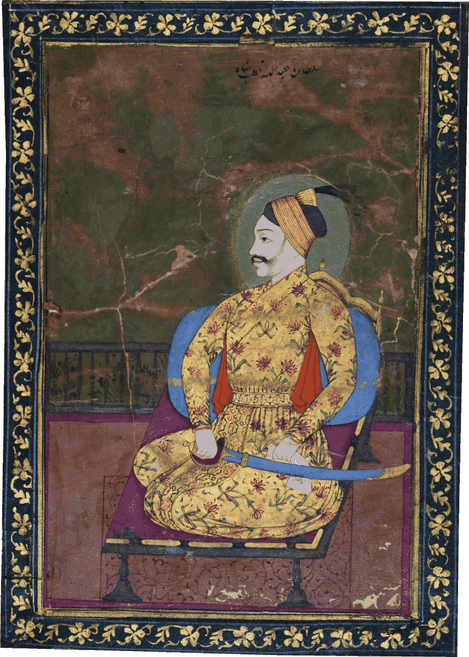
A portrait of Sultan Abdullah Qutb Shah is in the National Museum, New Delhi. Consider the following statements about it.
(A) There is an inscription on the top in Devanagari.
(B) The sultan is shown enthroned.
(C) The sultan’s state attracted scholars and artists from various parts of the world.
(D) The sword in the sultan’s hand symbolises his divinity.
How many of the statements given above are correct?
Answer & explanation
Correct answer: option 2
The correct answer is Option (2) → Two
(A) There is an inscription on the top in Devanagari. — Incorrect. The inscription on the top is in Persian. Devanagari letters appear on the domes of Ragini Pathamsika of Raga Hindola.
(B) The sultan is shown enthroned. — Correct. He is shown enthroned.
(C) The sultan’s state attracted scholars and artists from various parts of the world. — Correct. His famous Deccani state drew scholars and artists from many lands.
(D) The sword in the sultan’s hand symbolises his divinity. — Incorrect. The sword symbolises his political sovereignty. His divinity is shown by the halo round his head.
Note: This topic was not named in the CUET 2026 syllabus, but it was part of the NCERT chapter. In 2025 and 2026, NTA also asked questions on topics in NCERT that the CUET syllabus did not name. So our mocks have questions from every part of the NCERT chapter, to give you enough practice. Read the whole chapter, not only the sub-topics named in the syllabus.
NCERT (2026-27): “Sultan Abdullah Qutb Shah An important portrait of Sultan Abdullah Qutb Shah of Bijapur is in the collection of National Museum, New Delhi, India. There is an inscription on the top in Persian. Sultan Abdullah Qutb Shah was an able ruler of the famous Deccani state of Bijapur, which attracted scholars and artists from various parts of the world. Here, he is enthroned and we can see him holding the sword in one hand, symbolising his political sovereignty. Besides, a halo is seen around his head, which depicts his divinity.”
|