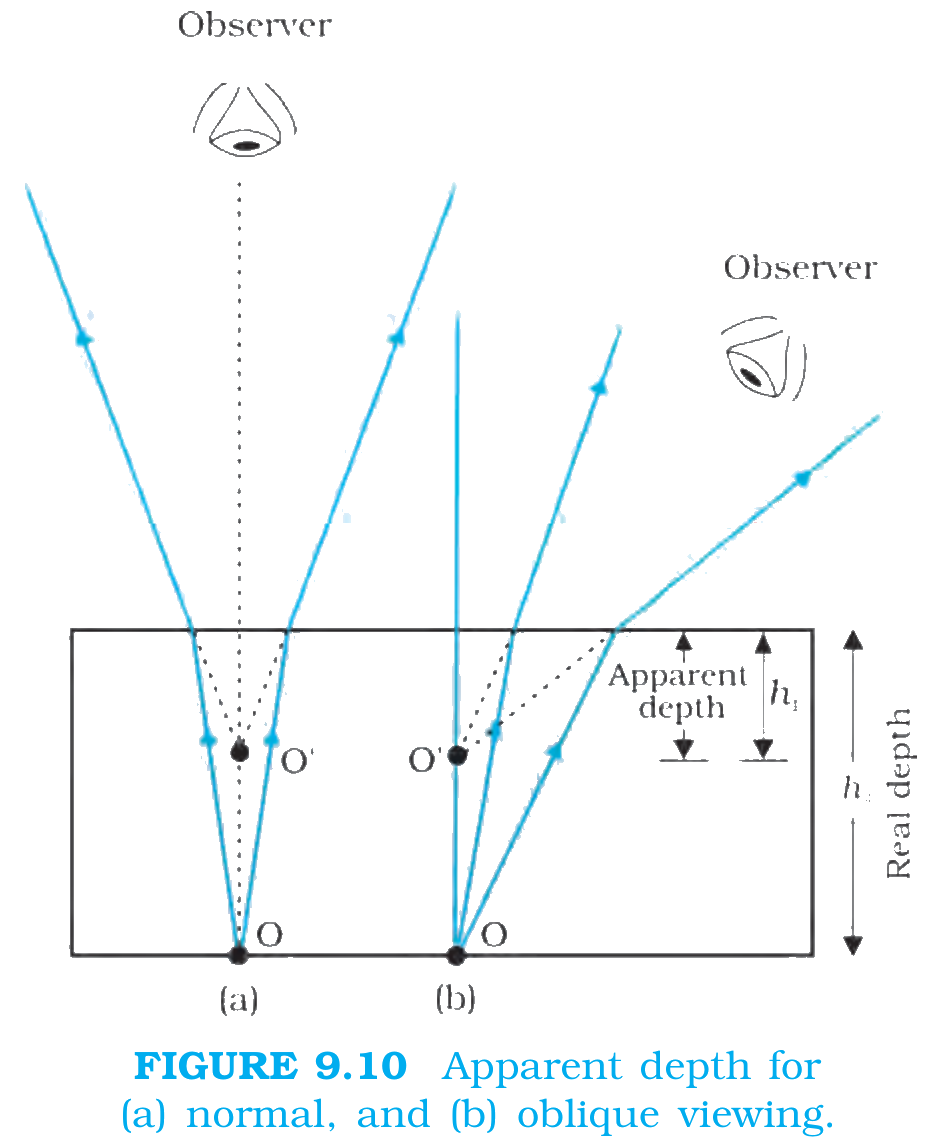
A coin lying at the bottom of a tank filled with water appears to be raised. Which phenomenon is responsible for this?
Answer & explanation
Correct answer: option 2
The correct answer is Option (2) → Refraction
Option (1) Total internal reflection — Incorrect. Total internal reflection sends the light back into the water. It needs an angle of incidence above the critical angle. The light by which we see the coin leaves the water near the normal and reaches the eye.
Option (2) Refraction — Correct. Light from the coin bends away from the normal as it passes from water into air. Traced back, the refracted rays appear to come from a point above the coin. So the coin is seen at an apparent depth, equal to the real depth divided by the refractive index of water.
Option (3) Reflection — Incorrect. The light seen by the observer crosses the water surface. Reflection at that surface only turns light back into the water. It does not shift the position of the coin.
Option (4) Scattering — Incorrect. Scattering sends light out in all directions from small particles. It does not make light from the coin appear to come from a raised point.
NCERT (2026-27):
Refraction – “Some elementary results based on the laws of refraction follow immediately. … Another familiar observation is that the bottom of a tank filled with water appears to be raised (Fig. 9.10). For viewing near the normal direction, it can be shown that the apparent depth (h1) is real depth (h2) divided by the refractive index of the medium (water).”