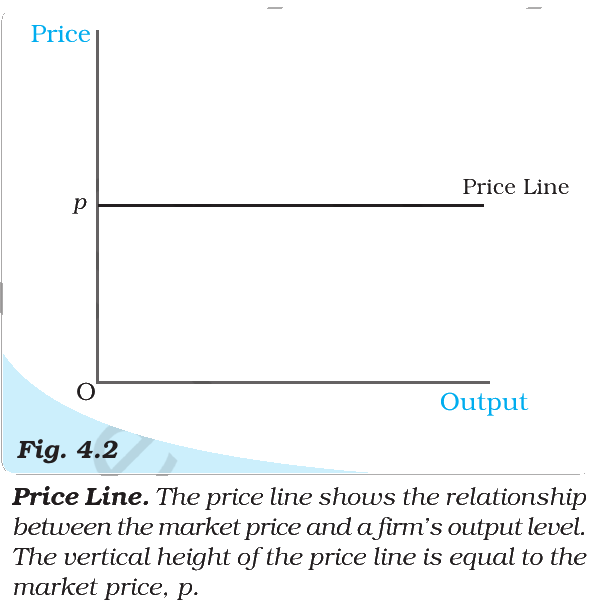
The demand curve facing a firm under perfect competition is perfectly elastic. This means that the firm:
Answer & explanation
Correct answer: option 2
The correct answer is Option (2) → can sell as many units as it wants at the market price
A perfectly elastic demand curve is horizontal at the market price. The firm can sell any amount at that price, but nothing above it.
Option (1) can raise its price a little without losing any of its sales — Incorrect. A firm that raises its price above the market price loses all its buyers.
Option (2) can sell as many units as it wants at the market price — Correct. This is what a horizontal demand curve means.
Option (3) must lower its price in order to sell more units of the good — Incorrect. That describes a downward sloping demand curve. This firm sells more at the same price.
Option (4) sells the same quantity of the good whatever the market price — Incorrect. A fixed quantity at every price describes a vertical curve, the opposite case.
NCERT (2026-27): “4.2 Revenue … Now consider Figure 4.2. Here, we plot the average revenue or market price (y-axis) for different values of a firm’s output (x-axis). Since the market price is fixed at p, we obtain a horizontal straight line that cuts the y-axis at a height equal to p. This horizontal straight line is called the price line. It is also the firm’s AR curve under perfect competition The price line also depicts the demand curve facing a firm. Observe that the demand curve is perfectly elastic. This means that a firm can sell as many units of the good as it wants to sell at price p.”
|