Which one is generally used to prevent the corrosion of metals in the presence of atmospheric oxygen?
Answer & explanation
Correct answer: option 2
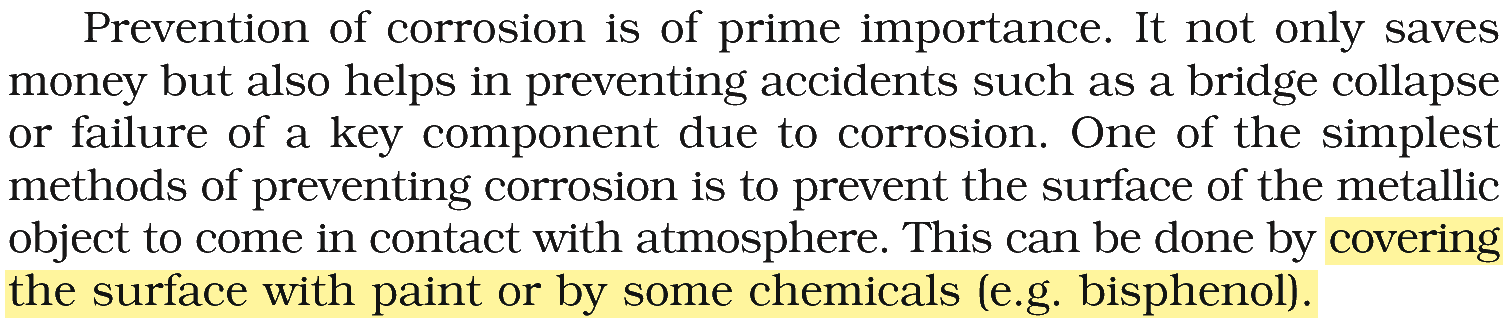
The correct answer is Option (2) → Bisphenol
Corrosion of a metal such as iron is an electrochemical process. At one spot on the surface iron is oxidised, and at another spot oxygen from the air is reduced in the presence of water:
\( \displaystyle \text{Anode: }\ce{2Fe -> 2Fe^2+ + 4e^-} \)
\( \displaystyle \text{Cathode: }\ce{O2 + 4H^+ + 4e^- -> 2H2O} \)
\( \displaystyle \text{Cell: }\ce{2Fe + O2 + 4H^+ -> 2Fe^2+ + 2H2O}\quad E^{\circ}_{cell}=1.67\ \mathrm{V} \)
The \( \ce{Fe^{2+}} \) ions are further oxidised by atmospheric oxygen to hydrated iron(III) oxide, which is rust:
\( \displaystyle \ce{4Fe^2+ + O2 + 4H2O -> 2Fe2O3 + 8H^+} \)
Corrosion can be prevented by keeping oxygen and moisture away from the surface or by protecting the metal electrically:
Barrier protection: covering the surface with paint or with chemicals such as bisphenol.
Sacrificial protection: coating with a more active metal such as zinc (galvanisation) or connecting it to magnesium, which corrodes first.
So the chemical generally used to prevent corrosion is bisphenol.
NCERT (2026-27 edition):
Corrosion – …