
The height of a cone is 20 cm. A small cone is cut off at the top by a plane parallel to the base. If the volume of smaller cone is \(\frac{1}{64}\)th of volume of the bigger cone, at what height above the base was the cut made?
Answer & explanation
Correct answer: option 3
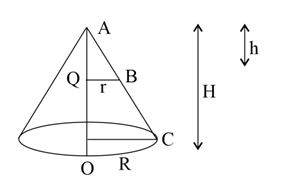
Assume QB is the point of cut for smaller cone.
In ΔAQB, ΔAOC; ∠A is common and QB ll OC
⇒ ΔAQB ∾ ΔAOC
⇒ \(\frac{AQ}{AO}\) = \(\frac{QB}{OC}\)
⇒ \(\frac{h}{H}\) = \(\frac{r}{R}\) ..... (i)
volume of smaller cone = \(\frac{1}{3}\) \(\pi \)r2h
volume of bigger cone = \(\frac{1}{3}\) \(\pi \)R2H
We know; \(\frac{1}{3}\) \(\pi \)r2h = \(\frac{1}{64}\) (\(\frac{1}{3}\) \(\pi \)R2H)
⇒ \(\frac{r^2}{R^2}\) = \(\frac{1}{64}\) (\(\frac{H}{h}\)) .... (ii)
From eqn. (i);
\(\frac{r}{R}\)2 = \(\frac{h^2}{H^2}\)
⇒ Putting eqn. (ii) \(\frac{h^2}{H^2}\) = \(\frac{1}{64}\) × \(\frac{H}{h}\)
⇒ h3 = \(\frac{H^3}{64}\)
⇒ h = \(\frac{H}{4}\) = \(\frac{20}{4}\) = 5 cm
So, required height= (20 - 5) = 15 cm