
CUETMOCK
  • Pricing
  • Mentors
Log inStart freeStart free mocks→

First test, then trust

Try a free CUET mock test.

Join 5,00,000+ students who rehearsed exam day on the exact NTA screen before sitting CUET. On the web and on Android.

Start free mocks →Get the Android app
CUETMOCK

India's #1 CUET Mock Test Platform. Original NCERT-based questions on the exact NTA exam screen — trusted by 5,00,000+ students since CUET 2022.

Get it onGoogle PlayScan to download the CUETMOCK app

Mock tests

  • CUET mock test series
  • Browse all papers
  • Commerce mocks
  • Humanities (Arts) mocks
  • Science mocks
  • Languages & GAT mocks
  • Free practice questions
  • Pricing

Resources

  • CUET exam guide
  • CUET syllabus
  • Universities accepting CUET
  • Expert blogs
  • News & notifications
  • Webinars & counselling
  • CUET score calculator
  • How we estimate your rank
  • FAQs

Company

  • About us
  • Our leadership & team
  • Our toppers
  • Mentors
  • For schools
  • Contact us
  • Terms
  • Privacy
  • Refund policy

Talk to us

+91 7696 6630 56info@cuetmock.comWhatsApp us

Our other platforms

  • JEE Mock — For IIT-JEE aspirants
  • NEET Mock — For NEET aspirants

Newsletter

Exam updates, study material and offers — no spam.

© 2026 NYC Ventures Pvt. Ltd.

701-702, Royal Business Park, Zirakpur, Punjab - 140603

  • Terms of use
  • Privacy policy
  • Refund policy
  • Contact us

iCUETMOCK is an independent preparation platform, not affiliated with the National Testing Agency (NTA). Always check exam details on the official NTA website.

  • Home
  • Mock tests
  • CUET guide
  • Pricing
  • Log in
Home/Practice questions/Physics
PhysicsCurrent Electricity

Identify the correct statement(s) from the following Resistivity ( ρ…

Identify the correct statement(s) from the following Resistivity (\( \rho \)) versus Temperature (T) graphs:
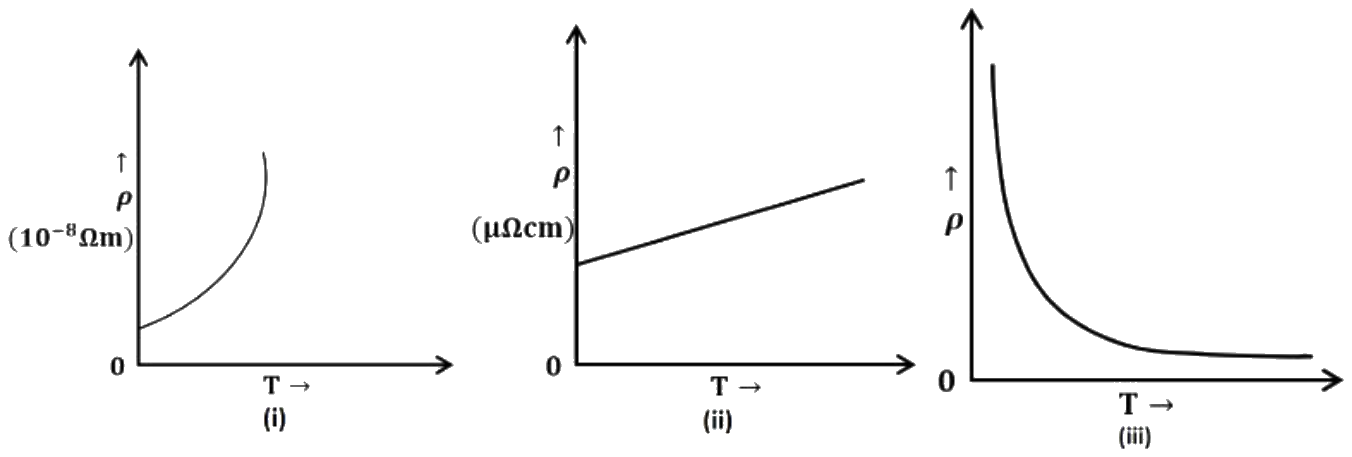
Figure for the question

(A) Graph (i), shows \( \rho \) versus T variation for Copper

(B) Graph (ii), shows \( \rho \) versus T variation for Silicon

(C) Graph (iii), shows \( \rho \) versus T variation for semiconductor

(D) Graph (iii), shows \( \rho \) versus T variation for Nichrome

Choose the correct answer from the options given below:

Answer & explanation+

Correct answer: option 2

The correct answer is Option (2) → (A) and (C) only

The three graphs show the three types of behaviour of resistivity with temperature: a metal, an alloy and a semiconductor.

(A) Graph (i), shows \( \rho \) versus T variation for Copper — Correct. The resistivity is of the order of \( 10^{-8}\,\Omega\,\mathrm{m} \) and rises with temperature, as for a metal.

(B) Graph (ii), shows \( \rho \) versus T variation for Silicon — Incorrect. Graph (ii) shows a large resistivity (in \( \mu\Omega\,\mathrm{cm} \)) that rises only slightly and linearly with temperature, which is the behaviour of an alloy such as nichrome. Silicon is a semiconductor, whose resistivity falls with temperature.

(C) Graph (iii), shows \( \rho \) versus T variation for semiconductor — Correct. The resistivity falls as the temperature rises, because more carriers are released.

(D) Graph (iii), shows \( \rho \) versus T variation for Nichrome — Incorrect. Nichrome has a high resistivity that changes very little with temperature; its resistivity does not fall steeply as in graph (iii).

NCERT (2026-27):
Resistivity of Various Materials – “… In between the two are the semiconductors. These, however, have resistivities characteristically decreasing with a rise in temperature.”


Temperature Dependence of Resistivity – “… For metals, \( \alpha \) is positive. The relation of Eq. (3.26) implies that a graph of \( \rho_T \) plotted against T would be a straight line. At temperatures much lower than 0°C, the graph, however, deviates considerably from a straight line (Fig. 3.8).”


Temperature Dependence of Resistivity – “… Some materials like Nichrome (which is an alloy of nickel, iron and chromium) exhibit a very weak dependence of resistivity with temperature (Fig. 3.9).”

Advertisement

Practise more on Current Electricity

Chapter-wise mocks on the real NTA exam screen, with solutions and your rank. Your first mocks are free.

Start free mocks →

Advertisement

Next questions

  1. Which of the following acids is a vitamin?Chemistry · Organic: Biomolecules
  2. Which quantity is represented by the relative lowering in vapour pressure of an ideal solution containing the non-volatile solute?Chemistry · Physical: Solutions
  3. The area of the sheet metal needed to make a box of size 7 cm × 8 cm × 9 cm is:General Aptitude Test · Quantitative Reasoning
  4. Physics · Ray Optics
  5. After offering a discount of 20% on an article, a trader earned a profit of 20%.If the cost price is ₹300, then what will be the selling pr…General Aptitude Test · Numerical Ability
  6. Which of the following statement is false?Chemistry · Physical: Chemical Kinetics
  7. Match column 1 with column 2 and choose the correct option from the given codes COLUMN 1 COLUMN 2 A. Darwin i. Abiogenesis B. Oparin ii. Us…Biology · Evolution
  8. In which of the following period Ostriches were found in India?General Aptitude Test · General Knowledge
  9. Consider a closed cylinder of radius r with a fixed surface area. The volume of the cylinder is maximum when its height isMaths. Section B1 · Applications of Derivatives
  10. Which year is known as "Year of Great Divide" in the history of Indian demography?Economics · Indian Economic Development: Indian Economy on the Eve of Independence