
Arrange the following in increasing order of their \( pK_a \) values.
(A) o-nitrophenol
(B) m-nitrophenol
(C) Phenol
(D) Ethanol
Choose the correct answer from the options given below:
Answer & explanation
Correct answer: option 1
The correct answer is Option (1) → (A), (B), (C), (D)
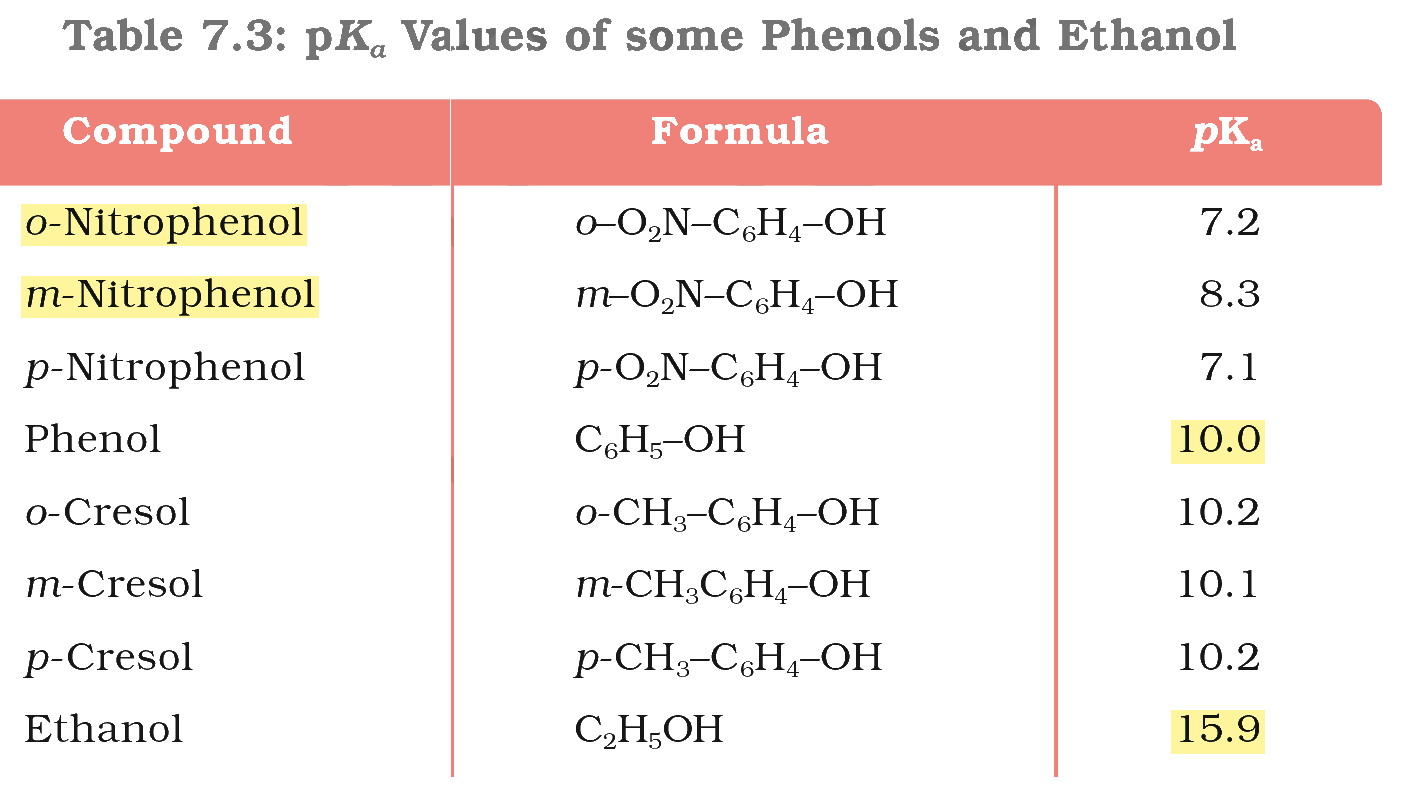
A lower pKa means a stronger acid (pKa = −log Ka), so the increasing order of pKa is the decreasing order of acidity. Two factors decide it:
Phenol vs alcohol: in the phenoxide ion the negative charge is delocalised over the benzene ring by resonance, so phenol loses \( \ce{H^{+}} \) far more easily than ethanol, whose ethoxide ion has no such stabilisation.
Nitro substituents: –\( \ce{NO2} \) is electron withdrawing and makes phenol more acidic. At the ortho and para positions it withdraws electrons by both resonance (−R) and the inductive effect (−I); at the meta position only the −I effect operates, so its effect is smaller.
Matching the given compounds:
(A) o-Nitrophenol
(B) m-Nitrophenol
(C) Phenol
(D) Ethanol
Shortcut: o-Nitrophenol (A) is the strongest acid (lowest pKa). Only Option (1) starts with (A).
NCERT (2026-27 edition):
Acidity of Phenols – …
Note: The same/similar question has been asked in different years by NTA as per the details given below:
| 2026 | 2025 | 2024 | 2023 | 2022 |
|---|---|---|---|---|
| 31-05 S2 | 02-06 S2 | – | – | – |