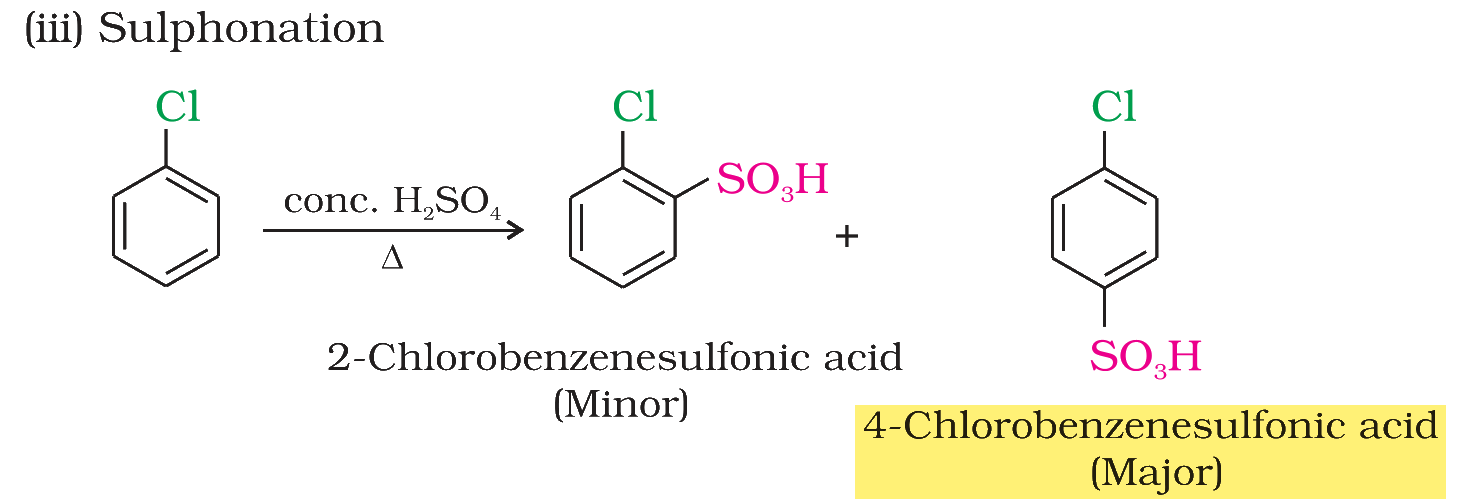
Haloarenes undergo the usual electrophilic reactions of the benzene ring such as halogenation, nitration, sulphonation and Friedel-Crafts reactions. Halogen atom besides being slightly deactivating is o, p-directing; therefore, further substitution occurs at ortho- and para-positions with respect to the halogen atom. The o, p-directing influence of halogen atom can be easily understood if we consider the resonating structures of halobenzene as shown:
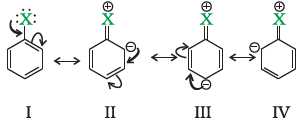 Due to resonance, the electron density increases more at ortho- and para-positions than at meta-positions. Further, the halogen atom because of its –I effect has some tendency to withdraw electrons from the benzene ring. As a result, the ring gets somewhat deactivated as compared to benzene and hence the electrophilic substitution reactions in haloarenes occur slowly and require more drastic conditions as compared to those in benzene.
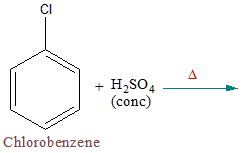
What is the major product of the reaction given below?
Answer & explanation
Correct answer: option 1
The correct answer is Option (1) → 4-Chlorobenzenesulfonic acid
Heating chlorobenzene with concentrated sulphuric acid is sulphonation, an electrophilic substitution of the ring. The passage states that the chlorine atom is o, p-directing, so the –SO3H group enters ortho or para to it. Of the two products, the para isomer is the major one:
\( \displaystyle \ce{C6H5Cl + H2SO4} \xrightarrow[\Delta]{\text{conc.}} \underset{\text{4-chlorobenzenesulfonic acid (major)}}{\ce{Cl-C6H4-SO3H}}\ce{ + H2O} \)
Why the other options are incorrect
Option (2) 2-Chlorobenzenesulfonic acid — Incorrect. The ortho isomer does form, but it is the minor product.
Option (3) An equal mixture of 2- and 4-chlorobenzenesulfonic acids — Incorrect. Both isomers form, but not in equal amounts; the para isomer is the major product.
Option (4) 3-Chlorobenzenesulfonic acid — Incorrect. The halogen is o, p-directing; resonance raises the electron density at the ortho and para positions, not at the meta position.
NCERT (2026-27 edition):
6.7.2 Reactions of Haloarenes