
Answer the questions on the basis of passage given below:
As aldehydes & ketones possess the carbonyl functional group, they show similar reactions. They exhibit nucleophilic addition reactions, reduction, oxidations, reactions due to α-hydrogen atom, and many other reactions, like Cannizzaro reaction to electrophilic substitution reactions (in case of aromatic aldehydes & ketones). These reactions help in the preparation of a number of important compounds, like acetic acid, vinyl acetate, polymers and in perfume and dye industries. Nucleophilic addition reactions form cyanohydrins, acetals, alcohols and N-substituted derivatives like imine, oxime, semicarbazone, phenylhydrazone & Schiff’s base. Reactions due to α-hydrogen atoms help in formation of aldols and α,β-unsaturated aldehydes & ketones.
When \(CH_3CHO\) and \(HCHO\) are reacted with \(NaOH(aq)\), one of the product is found to be
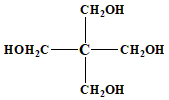 . The number of times aldol condensation and number of times Cannizzaro's reaction occur to produce the product
is:
Answer & explanation
Correct answer: option 2
The correct answer is Option (2) → 3, 1
The product shown is pentaerythritol, \( \ce{C(CH2OH)4} \). It is built in two stages. Ethanal has three α-hydrogens; methanal has none, so it acts only as the carbonyl acceptor.
Cross aldol reactions (three times): each α-hydrogen of ethanal is replaced in turn by a –\( \ce{CH2OH} \) group.
\( \displaystyle \ce{CH3CHO + HCHO} \xrightarrow{\text{dil. }\ce{OH-}} \ce{HOCH2CH2CHO} \)
\( \displaystyle \ce{HOCH2CH2CHO + HCHO} \xrightarrow{\text{dil. }\ce{OH-}} \ce{(HOCH2)2CHCHO} \)
\( \displaystyle \ce{(HOCH2)2CHCHO + HCHO} \xrightarrow{\text{dil. }\ce{OH-}} \ce{(HOCH2)3CCHO} \)
Crossed Cannizzaro reaction (once): \( \ce{(HOCH2)3CCHO} \) now has no α-hydrogen. With a fourth molecule of methanal and alkali, methanal is oxidised to formate and the other aldehyde is reduced to the alcohol.
\( \displaystyle \ce{(HOCH2)3CCHO + HCHO + OH^- -> C(CH2OH)4 + HCOO^-} \)
So the aldol reaction occurs three times and the Cannizzaro reaction once.
NCERT (2026-27 edition):
Cross Aldol Condensation – “When aldol condensation is carried out between two different aldehydes and / or ketones, it is called cross aldol condensation. If both of them contain α-hydrogen atoms, it gives a mixture of four products.”
Cannizzaro Reaction – “Aldehydes which do not have an α-hydrogen atom, undergo self oxidation and reduction (disproportionation) reaction on heating with concentrated alkali. In this reaction, one molecule of the aldehyde is reduced to alcohol while another is oxidised to carboxylic acid salt.”
Note: The same/similar question has been asked in different years by NTA as per the details given below:
| 2026 | 2025 | 2024 | 2023 | 2022 |
|---|---|---|---|---|
| – | – | – | 20-06 S3 12-06 S2 | – |