The order of reaction with rate law expression, \( \frac{d[R]}{dt} =-k \), is
Answer & explanation
Correct answer: option 1
The correct answer is Option (1) → 0
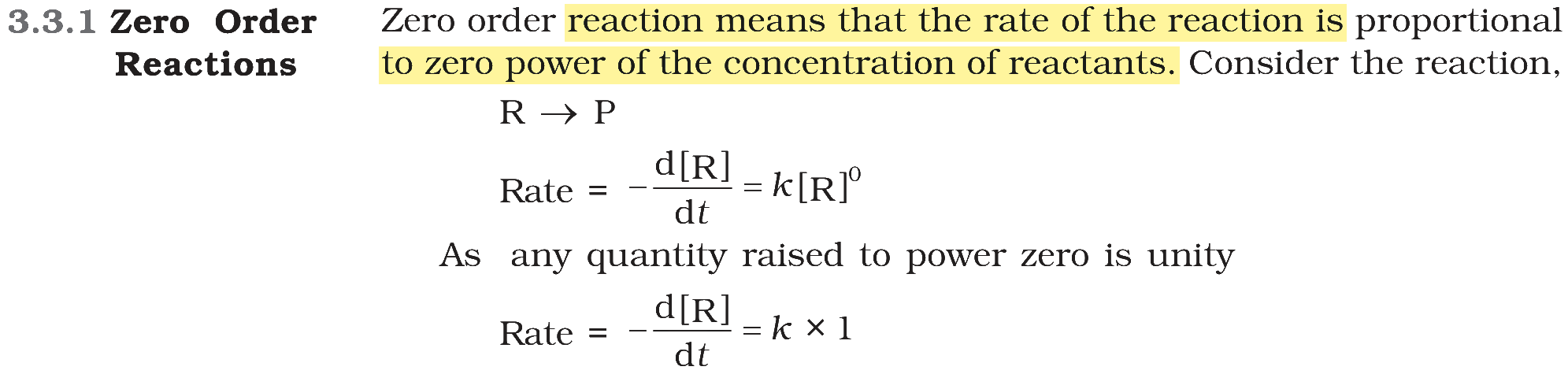
The order of a reaction is the power to which the concentration is raised in the rate law. For a reaction R → P of order n:
\( \displaystyle -\frac{d[\mathrm{R}]}{dt} = k[\mathrm{R}]^{n} \)
The given rate law, \( \frac{d[\mathrm{R}]}{dt} = -k \), is the same as \( -\frac{d[\mathrm{R}]}{dt} = k \).
The rate does not depend on the concentration at all; it stays constant until the reactant is used up. So the reaction is of zero order. Integrating gives a straight-line fall in concentration, \( [\mathrm{R}] = [\mathrm{R}]_0 - kt \). An example is the decomposition of ammonia on a hot platinum surface at high pressure, where the surface is fully covered and the rate is fixed:
\( \displaystyle \ce{2NH3(g)} \xrightarrow[\text{1130 K}]{\ce{Pt}} \ce{N2(g) + 3H2(g)} \qquad \text{Rate} = k \)
NCERT (2026-27 edition):
Zero Order Reactions