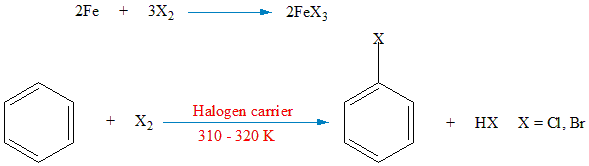
Chloroarenes (aryl chlorides) and bromoarenes (aryl bromides) can be easily prepared by direct chlorination or bromination of benzene or other aromatic hydrocarbons. These reactions are carried out in the dark, at ordinary temperatures (310–320 K), in the presence of a Lewis acid catalyst such as anhydrous ferric or aluminium halides (FeCl3, FeBr3, AlCl3). These reactions are called electrophilic substitution of arenes. The Lewis acid acts as a catalyst; its function is to carry the halogen to the aromatic hydrocarbon, so it is also called a halogen carrier. In actual practice, iron filings in the presence of chlorine or bromine are commonly used. The halogens react with iron filings to form the corresponding Lewis acids.
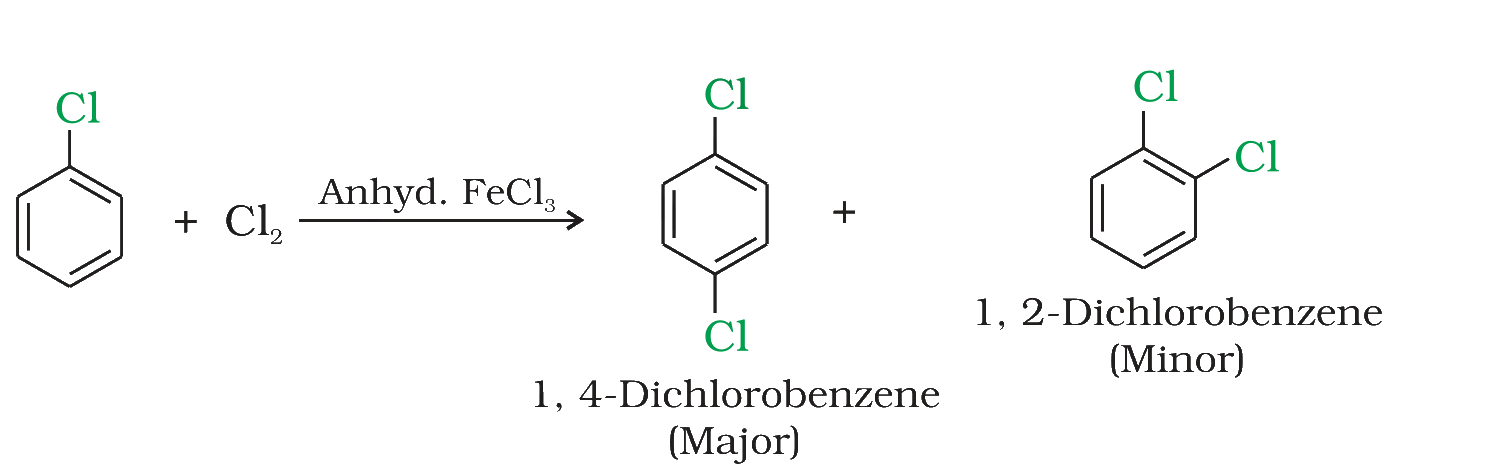
What is the major product formed when chlorobenzene reacts with chlorine in the presence of anhydrous FeCl3?
Answer & explanation
Correct answer: option 3
The correct answer is Option (3) → p-Dichlorobenzene
Chlorobenzene undergoes the usual electrophilic substitution of the benzene ring. The chlorine atom already on the ring is ortho, para-directing, so the second Cl enters at the ortho or para position:
\( \displaystyle \ce{C6H5Cl + Cl2} \xrightarrow{\text{anhyd. }\ce{FeCl3}} \ce{C6H4Cl2} \text{ (1,4- and 1,2-)} + \ce{HCl} \)
1,4-Dichlorobenzene (p-dichlorobenzene) is the major product and 1,2-dichlorobenzene the minor one.
Why the other options are incorrect
Option (1) o-Dichlorobenzene — Incorrect. It is formed, but only as the minor product.
Option (2) m-Dichlorobenzene — Incorrect. Chlorine directs the incoming group to ortho and para positions; resonance raises the electron density there more than at the meta position.
NCERT (2026-27 edition):
6.7.2 Reactions of Haloarenes: 2. Electrophilic substitution reactions – “Haloarenes undergo the usual electrophilic reactions of the benzene ring such as halogenation, nitration, sulphonation and Friedel-Crafts reactions. Halogen atom besides being slightly deactivating is o, p-directing; therefore, further substitution occurs at ortho- and para- positions with respect to the halogen atom.”
(i) Halogenation