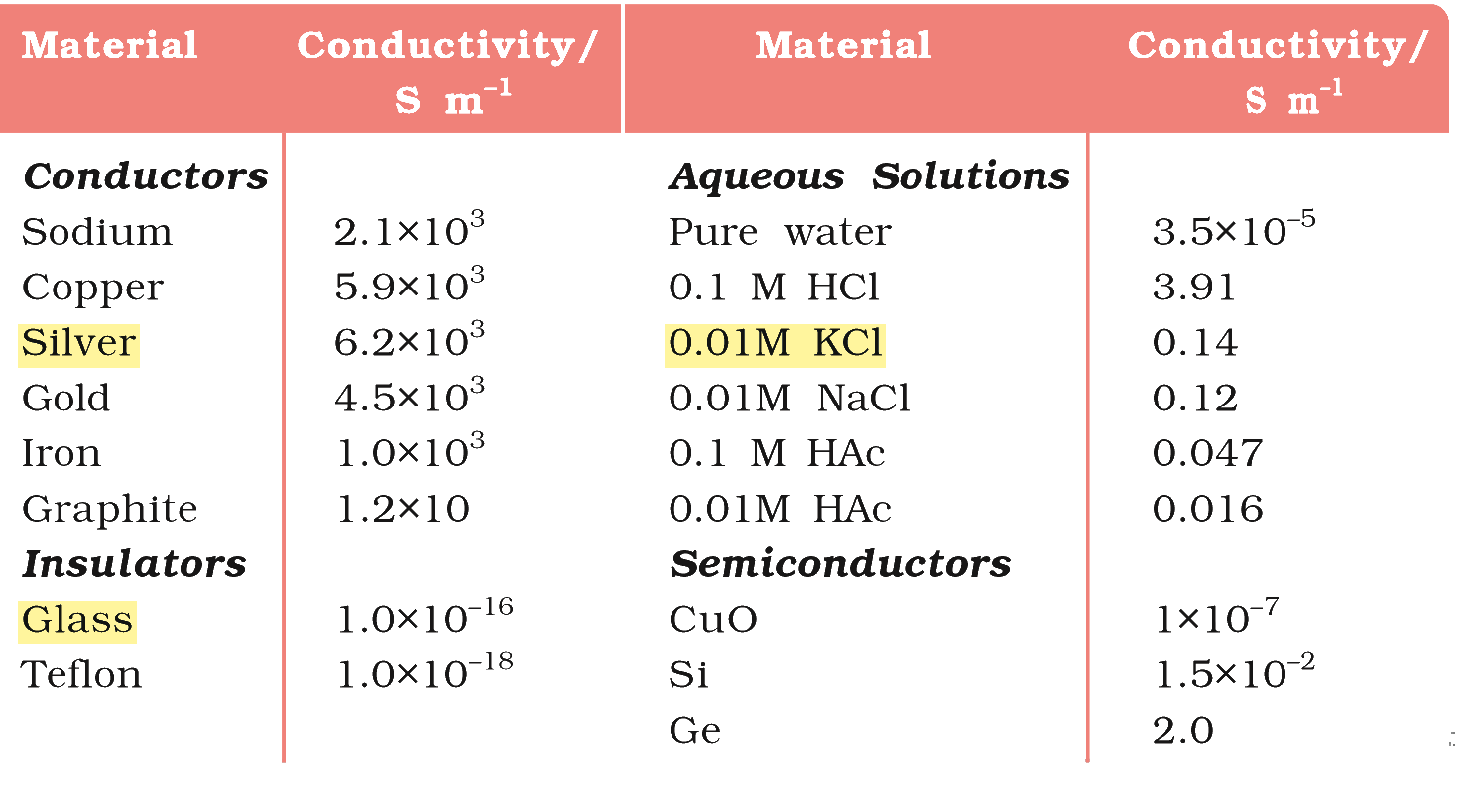
Match the conductivity values from List I with the material given in List II.
| LIST-I Values of conductivity in S m−1 at 298 K | LIST-II Material |
| A. 6.2 × 10³ | I. 0.01M KCl aqueous solution |
| B. 1.0 × 10⁻¹⁶ | II. Glass |
| C. 0.14 | III. Silicon |
| D. 1.5 × 10⁻² | IV. Silver |
Choose the correct answer from the options given below:
Answer & explanation
Correct answer: option 2
The correct answer is Option (2) → A-IV, B-II, C-I, D-III
The conductivity (κ, unit S m−1) of materials covers an enormous range. Metals are the best conductors, semiconductors lie in the middle, electrolytic solutions of moderate concentration are in the same middle range, and insulators such as glass conduct almost nothing.
A. 6.2 × 10³ — This matches IV. Silver. It is the largest value in the list, and only a metal, with its freely moving electrons, conducts this well.
B. 1.0 × 10⁻¹⁶ — This matches II. Glass. Glass is an insulator: all its electrons are held in bonds, so its conductivity is extremely small.
C. 0.14 — This matches I. 0.01M KCl aqueous solution. The current is carried by the \( \ce{K^{+}} \) and \( \ce{Cl^{-}} \) ions; this dilute solution is used as the standard for finding the cell constant of conductivity cells.
D. 1.5 × 10⁻² — This matches III. Silicon. Silicon is a semiconductor, with a conductivity between those of metals and insulators.
Shortcut: The pair A–IV (the largest value for the metal) appears only in Option (2).
NCERT (2026-27 edition):
Conductance of Electrolytic Solutions – …