
Read the following information carefully to choose the best option for the question:
'P % Q' means that 'P is the sister of Q'
'P + Q' means that 'P is the son of Q'
'P × Q' means that 'P is the husband of Q'
'P - Q' means that 'P is the brother of Q'
Which of the following means 'A is the son-in-law of G'?
Answer & explanation
Correct answer: option 4
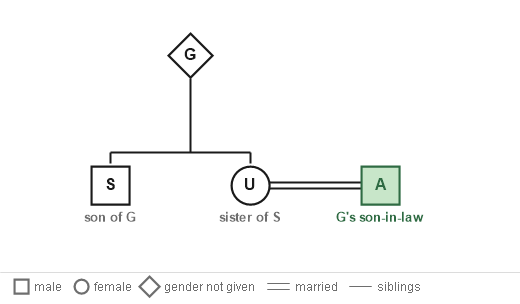
The correct answer is Option (4) → A × U % S + G
A son-in-law is the husband of one’s daughter. Each symbol stands for one relation, and a pair is read as “the letter on the left is the … of the letter on the right”:
P % Q means P is the sister of Q
P + Q means P is the son of Q
P × Q means P is the husband of Q
P - Q means P is the brother of Q
Option (4), A × U % S + G, breaks into three pairs:
A × U — A is the husband of U
U % S — U is the sister of S, so U is female
S + G — S is the son of G, so S’s sister U is G’s daughter
A is the husband of G’s daughter, so A is G’s son-in-law.
Why the other options are incorrect
Option (1) A × U + S × G — Incorrect. U + S makes U a son, while A × U makes U A’s wife, so the pairs contradict each other.
Option (2) A + S % U × G — Incorrect. A is the son of S, whose brother U is G’s husband, so A is the nephew of G’s husband.
Option (3) A - S + U × G — Incorrect. A is the brother of S, the son of U and G, so A is G’s son.