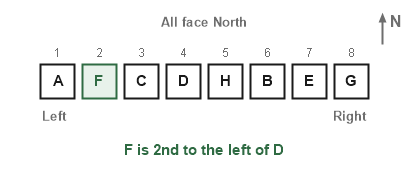
A, B, C, D, E, F, G and H are seated in a straight line facing North. G sits fifth to the right of C. D sits third to the right of A, but D is not an immediate neighbour of G. Both E and H are immediate neighbours of B. F sits third to the left of H.
Who sits second to the left of D?
Answer & explanation
Correct answer: option 3
The correct answer is Option (3) → F
Start with the pair whose gap is largest, C and G, try each possible place for them, and drop every case that breaks a condition. Seats are numbered 1 to 8 from the left. Since E and H are both next to B, E, B, H need three seats side by side, with B in the middle.
G is fifth to the right of C, so (C, G) is in seats (1, 6), (2, 7) or (3, 8)
C in seat 1, G in seat 6:
D is not next to G, so D is not in seat 5 or 7; with A three seats to the left of D, the only fit is A in seat 5, D in seat 8
Seats 2, 3, 4 and 7 are left; E, B, H must take seats 2, 3, 4, with H in seat 2 or 4
F is three seats to the left of H, which needs seat 1 (taken by C) or a seat before 1, so this case fails
C in seat 2, G in seat 7:
D cannot be in seat 6 or 8, so A is in seat 1 and D in seat 4
Seats 3, 5, 6 and 8 are left, and no three of them are side by side for E, B, H, so this case fails
C in seat 3, G in seat 8:
D cannot be in seat 7, and D in seat 6 would put A in seat 3 (C’s seat), so (A, D) is (1, 4) or (2, 5)
With A in seat 2 and D in seat 5, seats 1, 4, 6, 7 are left, with no three side by side, so this fails
With A in seat 1 and D in seat 4, E, B, H take seats 5, 6, 7 with B in seat 6
F is three seats to the left of H: H in seat 7 would put F in seat 4 (D’s seat), so H is in seat 5 and F in seat 2; E is in seat 7
The only line is A, F, C, D, H, B, E, G. D is in seat 4, so the person second to the left of D, in seat 2, is F