
One mole of an ideal diatomic gas undergoes a transition from A to B along a path AB as shown in the figure :
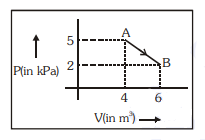
The change in internal energy of the gas during the transition is :
Answer & explanation
Correct answer: option 1
\(\Delta U = n C_v \Delta T\) ;
T = \(\frac{PV}{nR}\)
\(\Delta T = T_2 - T_1\)
\(\Delta T = \frac{P_2V_2 - P_1V_1}{nR} \)
\(\Delta U = \frac{nR}{\Gamma - 1} \frac{P_2V_2 - P_1V_1}{nR} \)
\(\Delta U = \frac{P_2V_2 - P_1V_1}{\Gamma - 1}\)
\(\Delta U = - 20 kJ\)