
Read the passage and answer the following questions:
A typical angiosperm anther is bilobed with each lobe having two theca, i.e., they are dithecous. The anther is a four-sided (tetragonal) structure consisting of four microsporangia located at the corners, two in each lobe. The microsporangia develop further and become pollen sacs. They extend longitudinally all through the length of an anther and are packed with pollen grains. In a transverse section, a typical microsporangium appears near circular in outline. It is generally surrounded by four wall layers. When the anther is young, a group of compactly arranged homogenous cells called the sporogenous tissue occupies the centre of each microsporangium. As the anther develops, the cells of the sporogenous tissue undergo meiotic divisions to form microspore tetrads. As the anthers mature and dehydrate, the microspores dissociate from each other and develop into pollen grains. Inside each microsporangium several thousands of microspores or pollen grains are formed that are released with the dehiscence of anther.
Choose the incorrect statements from the following:
A. The proximal end of the filament of a stamen is attached to the thalamus or the petal of the flower.
B. In a typical angiosperm anther, a longitudinal groove often runs lengthwise separating the theca.
C. In a stamen, the terminal and generally bilobed structure is called the filament.
D. In a mature pollen grain, the vegetative cell is spindle shaped with dense cytoplasm and a nucleus.
Choose the correct answer from the options given below:
Answer & explanation
Correct answer: option 4
The correct answer is Option (4) → C and D only
A stamen has two parts, the long slender filament and the terminal, generally bilobed anther. A mature pollen grain has two cells, a large vegetative cell and a small generative cell.
A. The proximal end of the filament of a stamen is attached to the thalamus or the petal of the flower. — True. The proximal end of the filament is attached to the thalamus or the petal.
B. In a typical angiosperm anther, a longitudinal groove often runs lengthwise separating the theca. — True. The anther is dithecous, and a longitudinal groove often separates the two theca.
C. In a stamen, the terminal and generally bilobed structure is called the filament. — False. The terminal bilobed structure is the anther. The filament is the long and slender stalk.
D. In a mature pollen grain, the vegetative cell is spindle shaped with dense cytoplasm and a nucleus. — False. It is the generative cell that is small and spindle shaped with dense cytoplasm. The vegetative cell is bigger, has abundant food reserve and a large irregularly shaped nucleus.
NCERT Extract:
1.2.1 Stamen, Microsporangium and Pollen Grain – “… Figure 1.2a shows the two parts of a typical stamen – the long and slender stalk called the filament, and the terminal generally bilobed structure called the anther. The proximal end of the filament is attached to the thalamus or the petal of the flower. … A typical angiosperm anther is bilobed with each lobe having two theca, i.e., they are dithecous (Figure 1.2b). Often a longitudinal groove runs lengthwise separating the theca.”
Pollen grain – “… The vegetative cell is bigger, has abundant food reserve and a large irregularly shaped nucleus. The generative cell is small and floats in the cytoplasm of the vegetative cell. It is spindle shaped with dense cytoplasm and a nucleus.”
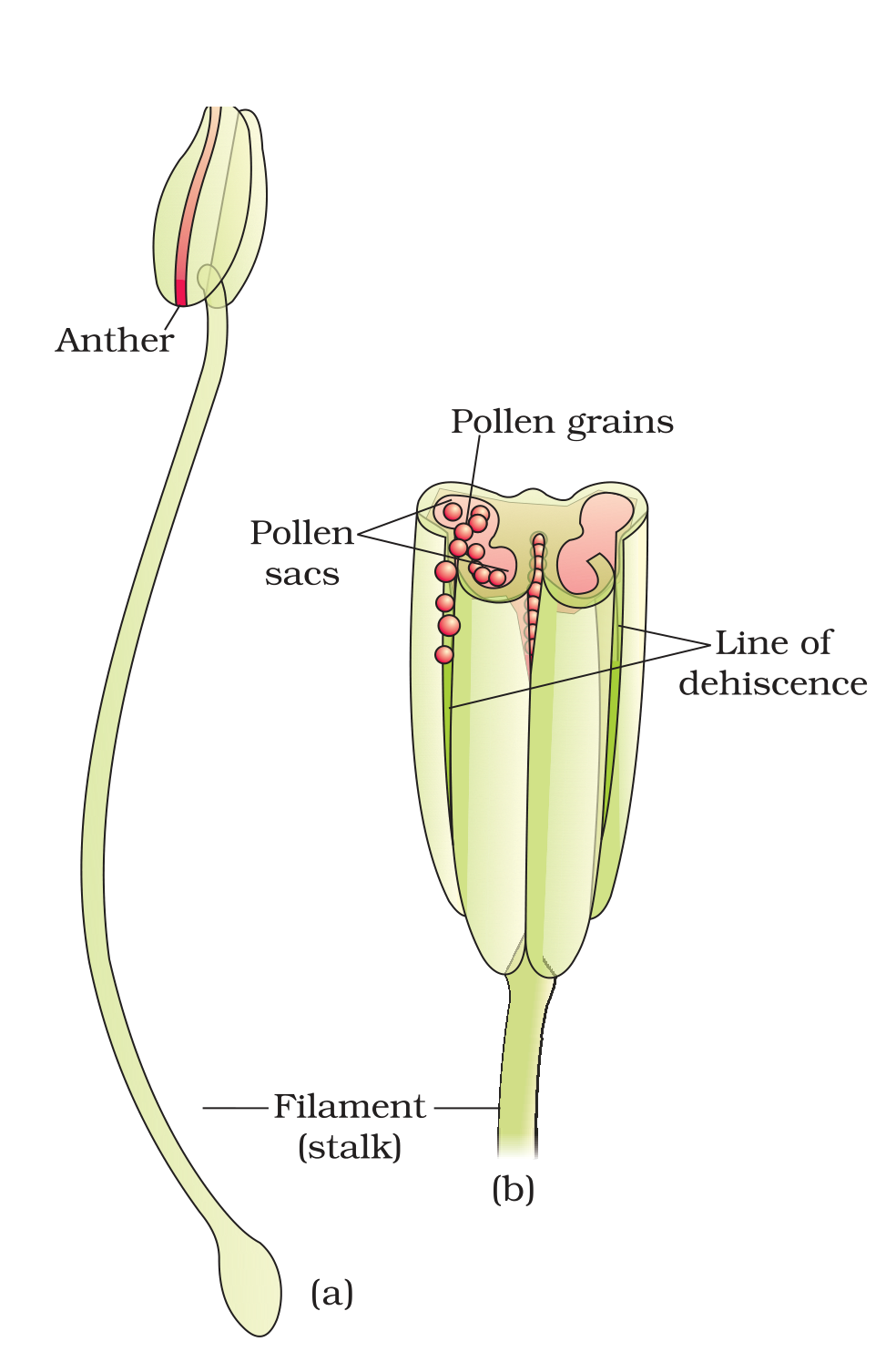
Figure 1.2 (a) A typical stamen; (b) three–dimensional cut section of an anther