
The reaction of phenol with chloroform in the presence of sodium hydroxide gives
Answer & explanation
Correct answer: option 3
The correct answer is Option (3) → Salicylaldehyde
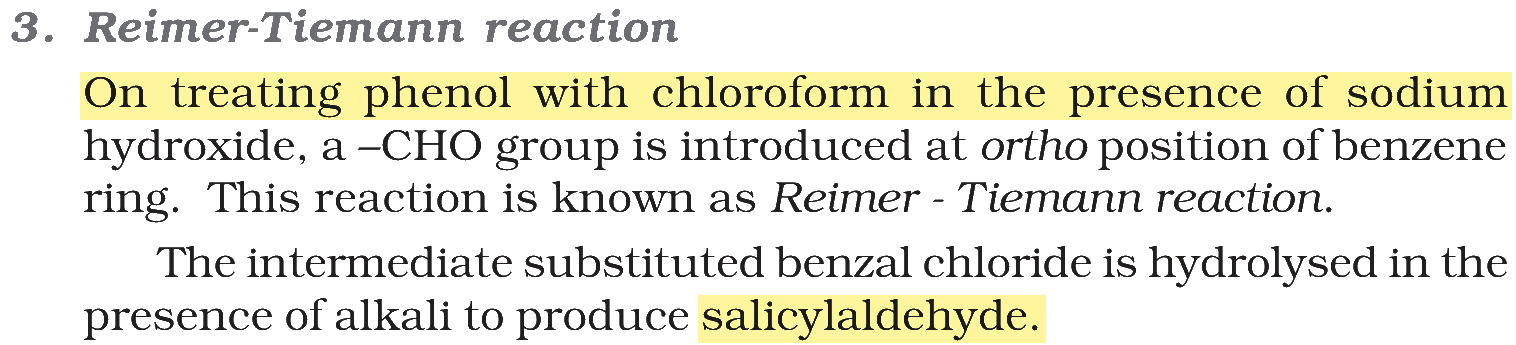
In the Reimer–Tiemann reaction, phenol is treated with chloroform in the presence of aqueous sodium hydroxide, and a –CHO group is introduced at the ortho position of the benzene ring. The phenoxide ion, whose ring is strongly activated, is attacked by dichlorocarbene, \( \ce{:CCl2} \), formed from chloroform and alkali. The substituted benzal chloride formed first is hydrolysed by the alkali, and acidification gives salicylaldehyde (2-hydroxybenzaldehyde):
\( \displaystyle \ce{C6H5OH} \xrightarrow{\ce{CHCl3} + \text{aq. }\ce{NaOH}} o\text{-}\ce{NaOC6H4CHCl2} \xrightarrow{\text{aq. }\ce{NaOH}} o\text{-}\ce{NaOC6H4CHO} \xrightarrow{\ce{H+}} o\text{-}\ce{HOC6H4CHO} \)
So the product is salicylaldehyde.
Why the other options are incorrect
Option (1) Salicylic acid — Incorrect. Salicylic acid (2-hydroxybenzoic acid) is made from sodium phenoxide and carbon dioxide by Kolbe’s reaction, not with chloroform.
\( \displaystyle \ce{C6H5ONa} \xrightarrow[\text{(ii) }\ce{H+}]{\text{(i) }\ce{CO2},\ 400\,\text{K},\ 4\text{-}7\,\text{atm}} o\text{-}\ce{HOC6H4COOH} \)
Option (2) Acetylsalicylic acid — Incorrect. This is aspirin, made by acetylation of salicylic acid with acetic anhydride; it needs salicylic acid as the starting material.
\( \displaystyle o\text{-}\ce{HOC6H4COOH + (CH3CO)2O} \xrightarrow{\ce{H+}} o\text{-}\ce{CH3COOC6H4COOH + CH3COOH} \)
Option (4) mixture of ortho and para chlorophenols — Incorrect. These are formed when phenol is treated with chlorine in a solvent of low polarity; chloroform does not chlorinate the ring but supplies the carbon of the –CHO group.
NCERT (2026-27 edition):
Reimer-Tiemann Reaction
Note: The same/similar question has been asked in different years by NTA as per the details given below:
| 2026 | 2025 | 2024 | 2023 | 2022 |
|---|---|---|---|---|
| – | 14-05 S2 | – | 02-07 S3 20-06 S3 | – |