
Read the given statements and conclusions carefully assuming that the information given in the statements is true, even if it appears to be at variance with commonly known facts. Decide which of the given conclusion(s) logically follows from the statements.
Statements:
No keyboard is a mouse.
All mouses are computers.
All computers are laptops.
Conclusions:
I. All mouses are laptops.
II. All computers can never be keyboards.
Answer & explanation
Correct answer: option 4
The correct answer is Option (4) → Both conclusions I and II follow
In a syllogism, a conclusion follows only if it is true in every diagram the statements allow. Here the mouses lie inside the computers, the computers inside the laptops, and the keyboards stay outside the mouses; whether keyboards overlap the other computers or the laptops is left open (dashed circle).
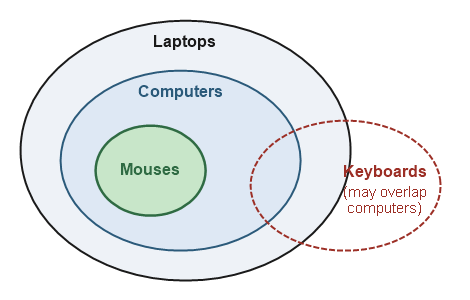
I. All mouses are laptops. Follows. Every mouse is a computer and every computer is a laptop, so every mouse is a laptop.
II. All computers can never be keyboards. Follows. The mouses are computers, and no mouse is a keyboard. So at least these computers are not keyboards, and it can never happen that all computers are keyboards.
Note: Conclusion II can be read in two ways.
“It can never happen that all computers are keyboards” (some computers are not keyboards): this follows, as shown above. This reading gives Option (4).
“No computer can ever be a keyboard”: this does not follow, because the statements say nothing about the computers that are not mouses, and keyboards may be among them. This reading gives Option (1).
In syllogism questions the form “All A can never be B” is used in the first sense, which is why Option (4) is the most appropriate answer.