Arrange the following stages of business idea generation in a logical sequence.
(A) Examine the idea for its real life use and application.
(B) Decide the level of operation
(C) Identify the technology required to produce the product
(D) Obtain a concept of the product suggested by one idea.
Choose the correct answer from the options given below:
Answer & explanation
Correct answer: option 1
The correct answer is Option (1) → (D), (A), (B), (C)
Step 1 — (D) Obtain a concept of the product suggested by one idea. An idea must first be turned into a clear product: what it is and what need it meets. Nothing else can be checked or planned before this.
Step 2 — (A) Examine the idea for its real life use and application. Once the product is clear, the entrepreneur checks if people will really use it and buy it. An idea with no real use is dropped here.
Step 3 — (B) Decide the level of operation. Only a useful product is taken further. Now the entrepreneur decides how big the business will be, that is, how much to produce.
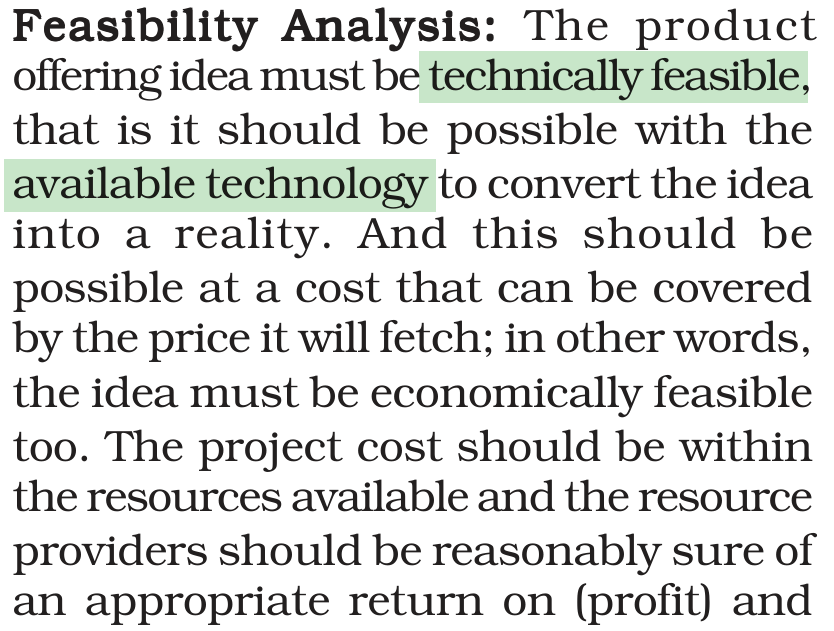
Step 4 — (C) Identify the technology required to produce the product. The right technology depends on both the product and the scale of production. So it is chosen last. The idea must also be technically feasible, that is, possible to make with the available technology.
Note 1: This question is from the chapter Entrepreneurship Development, which is not in the current NCERT book (2026-27). The chapter is in the pre-rationalised NCERT, from which the extract below is taken. Note 2: The stages of business-idea generation in this question are not given in any NCERT edition. The answer rests on the logic of each step, explained above. The extract below is the nearest NCERT passage: first the product idea is formed, then it is checked whether it can be made with the available technology. NCERT (Pre-rationalised Edition): “Roles and Functions of the Entrepreneur in relation the Enterprise … In terms of the process of setting up a business, therefore, an entrepreneur is on the look out for and spots the business opportunity, assesses its value, develops it in the form of a product/service idea, assembles he resources and gets going.” “Identification of Specific Product Offering: … Deciding on the product offering makes the highest demand on the entrepreneur’s creativity and innovativeness. Yet, in a competitive environment, it is possible to differentiate your product offering even if the generic product is the same and serves the same need. Clearly decision on specific product offering necessitates decisions on who is buying, why, and what are the value expectations. …”
|