
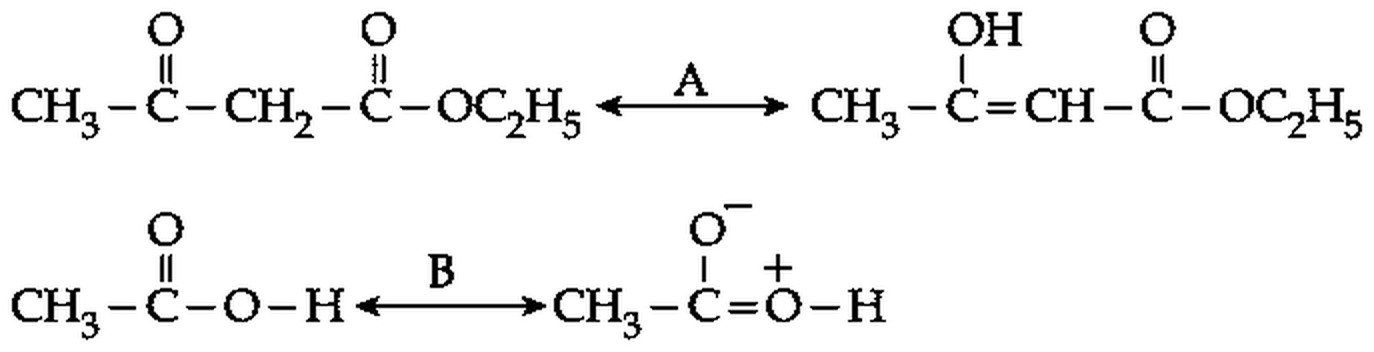
A and B represent :
Answer & explanation
Correct answer: option 1
The correct answer is Option (1) → Tautomerism and Resonance
The two kinds of double-headed relationship are different in nature:
Tautomerism is the existence of two real, interconvertible isomers that differ in the position of a hydrogen atom (and of a double bond). They are in equilibrium and can in principle be separated. The common case is keto-enol tautomerism.
Resonance is the description of one molecule by two or more structures that differ only in the position of electrons; all atoms stay in place. The structures are not real compounds; the actual molecule is their hybrid. It is shown with a double-headed arrow (↔).
A: in ethyl acetoacetate (keto form) a hydrogen moves from the \( \ce{CH2} \) carbon to the carbonyl oxygen, and the C=O becomes C=C–OH (enol form). A hydrogen atom changes position, so this is keto-enol tautomerism:
\( \displaystyle \ce{CH3-CO-CH2-COOC2H5 <=> CH3-C(OH)=CH-COOC2H5} \)
B: in acetic acid only electrons move: a lone pair of the −OH oxygen forms a C=O+ bond while the π electrons of C=O move onto the other oxygen. No atom moves, so the two structures are resonance structures of the same molecule.
So A and B represent tautomerism and resonance.
Why the other options are incorrect
Option (2) Metamerism and Resonance — Incorrect. Metamerism is isomerism due to different alkyl groups on either side of a functional group (e.g. \( \ce{C2H5OC2H5} \) and \( \ce{CH3OC3H7} \)); in A the alkyl groups are unchanged and a hydrogen shifts.
Option (3) Resonance and Tautomerism — Incorrect. This reverses the two; in A a hydrogen atom changes position (not allowed in resonance), and in B only electrons move (no tautomer is formed).
Option (4) Metamerism and Tautomerism — Incorrect. A is not metamerism (no change of alkyl groups) and B is not tautomerism (no hydrogen shift).
Note: The question is from beyond the NCERT textbook.