
A can do \(\frac{3}{4}\)th of work in 90 days and B can do \(\frac{2}{5}\)th of same work in 64 days. If a and B start working together and worked for X days and after that C joined them and remaining work is completed in next (x-15) days. If efficiency of C is \(\frac{1}{3}\)rd of B. Find in (x+20) days how much percent of work is done by A and C?
Answer & explanation
Correct answer: option 3
A can complete the whole work in = 90 × \(\frac{4}{3}\) = 120 days
B can complete the whole work in = 64 × \(\frac{5}{2}\) = 160 days
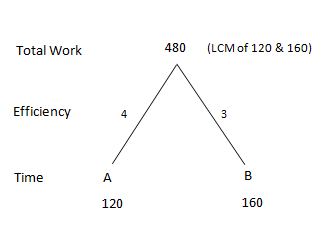
C's efficiency = \(\frac{1}{3}\)rd of B
= \(\frac{1}{3}\) × 3 = 1
ATQ,
(A + B)’s × days work + (A + B + C) (x - 15) days work = Total work
7x + 8 (x-15) = 480
15 x = 600
x = 40
For (x + 20) days both ( A + C ) will work
(x + 20) days = (40 + 20) = 60 days
Total work = Efficiency × Number of days
work done by (A + C ) for 60 days = 60 × (4 + 1) = 300
Required % = \(\frac{300}{480}\) × 100 = 62.5%