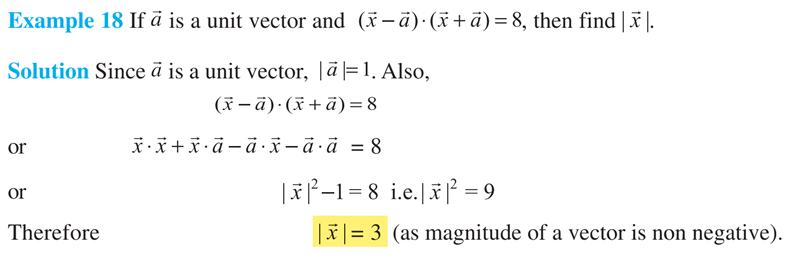
If \(\vec a\) is a unit vector and \((\vec x - \vec a) \cdot (\vec x + \vec a) = 15\), then the value of \(|\vec x|\) is:
Answer & explanation
Correct answer: option 3
The correct answer is Option (3) → 4
Expanding the dot product (the cross terms cancel, since \(\vec x \cdot \vec a = \vec a \cdot \vec x\)):
\((\vec x - \vec a) \cdot (\vec x + \vec a) = \vec x \cdot \vec x + \vec x \cdot \vec a - \vec a \cdot \vec x - \vec a \cdot \vec a\)
\(= |\vec x|^2 - |\vec a|^2\)
Since \(\vec a\) is a unit vector, \(|\vec a| = 1\):
\(|\vec x|^2 - 1 = 15\)
\(|\vec x|^2 = 16\)
\(|\vec x| = 4\)
Why the other options are incorrect
Option (1) 0 — Incorrect. \(|\vec x| = 0\) gives \(0 - 1 = -1\), not 15.
Option (2) 16 — Incorrect. 16 is \(|\vec x|^2\); the magnitude is its square root.
Option (4) 2 — Incorrect. \(|\vec x| = 2\) gives \(4 - 1 = 3\), not 15.
NCERT (2026-27 edition):
Scalar (or Dot) Product of Two Vectors