
Which of the following graphs, indicates a ohmic conductor for all the voltages applied.
Answer & explanation
Correct answer: option 3
The correct answer is Option (3)
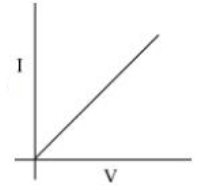
A conductor is ohmic when it obeys Ohm's law, \( V = IR \) with a constant R. Its I–V graph is then a straight line through the origin (\( I\propto V \)), and it must stay straight for all the applied voltages.
Only the graph of Option (3) is a straight line through the origin over the whole range.
Why the other options are incorrect
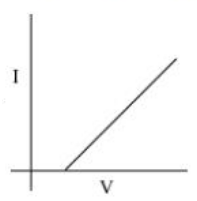
Option (1) — Incorrect. The line does not pass through the origin: there is no current until a certain voltage is reached, so I is not proportional to V.
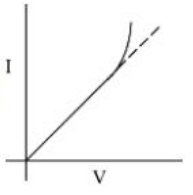
Option (2) — Incorrect. The graph is straight at low voltages but bends upwards at higher ones, so Ohm's law fails there.
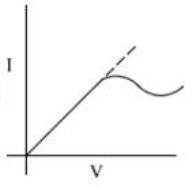
Option (4) — Incorrect. The graph is straight at first, but at higher voltages the current stops rising and then falls, so the conductor is not ohmic for all voltages.
NCERT (2026-27):
Ohm’s Law – “… Imagine a conductor through which a current I is flowing and let V be the potential difference between the ends of the conductor. Then Ohm’s law states that \( V \propto I \) or,
\( \displaystyle V = R I \qquad (3.3) \)
where the constant of proportionality R is called the resistance of the conductor.”
Limitations of Ohm’s Law – “… The deviations broadly are one or more of the following types: (a) V ceases to be proportional to I (Fig. 3.5).”