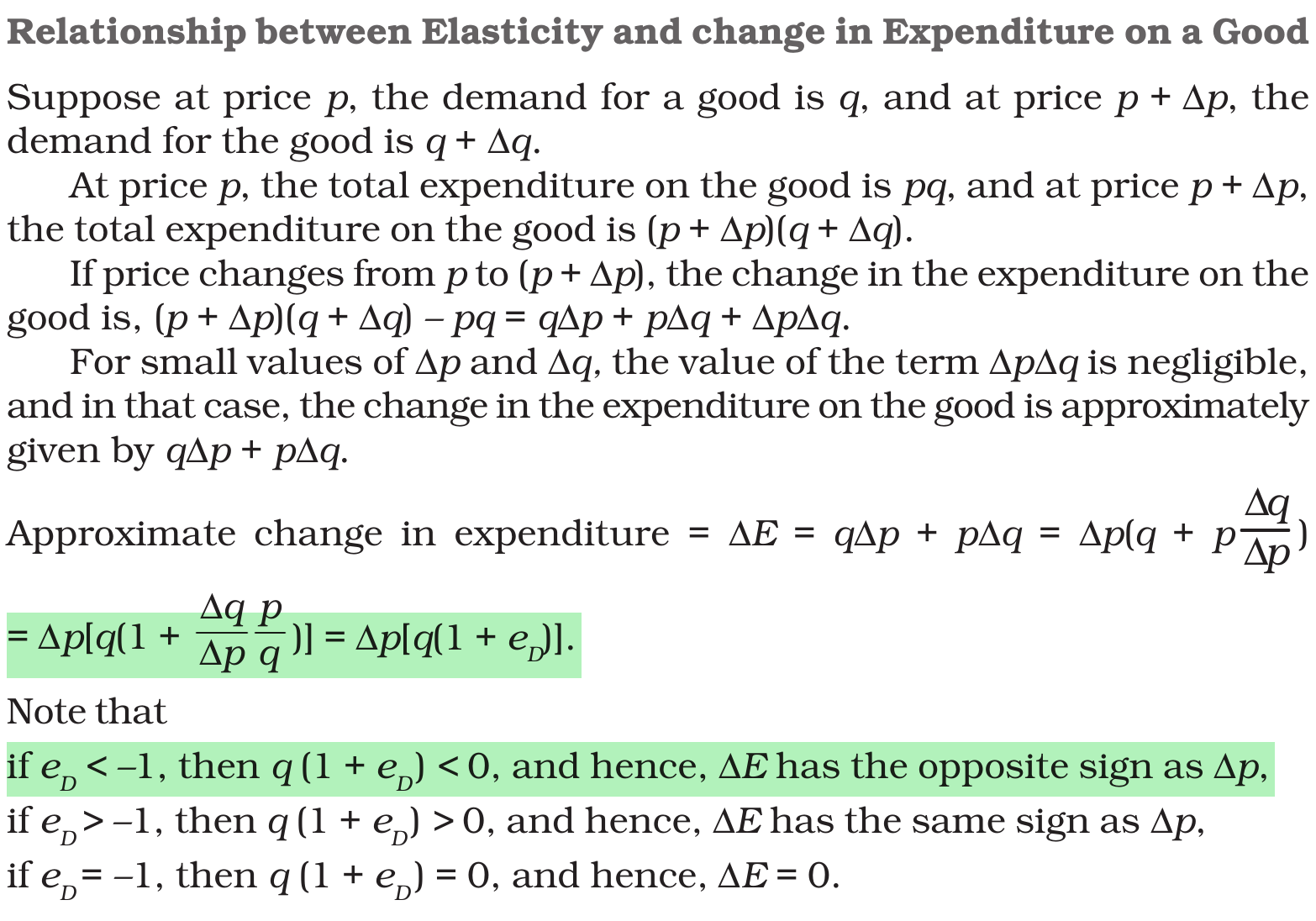
The \( q (1 + e_D) < 0 \), and hence, ΔE (expenditure) has the opposite sign as Δp (price), if _____.
Answer & explanation
Correct answer: option 2
The correct answer is Option (2) → \( e_D< -1 \)
When the price elasticity of demand (eD) is less than −1, the term q(1 + eD) is negative. So expenditure moves opposite to the price.
Expenditure on a good is price multiplied by quantity. For a small price change, the change in expenditure is approximately:
ΔE = Δp[q(1 + eD)]
Here q is always positive. So the sign of (1 + eD) decides how ΔE moves with Δp.
Option (1) \( e_D> -1 \) — Incorrect. The term q(1 + eD) is positive, so ΔE has the same sign as Δp. Expenditure rises when the price rises.
Option (2) \( e_D< -1 \) — Correct. Demand falls by a larger percentage than the price rises. So a rise in price lowers expenditure.
Option (3) \( e_D= -1 \) — Incorrect. The term q(1 + eD) is zero, so ΔE = 0. Expenditure does not change.
Option (4) \( e_D=0 \) — Incorrect. Quantity does not respond to price. The term equals q, which is positive, so ΔE has the same sign as Δp.
NCERT (2026-27): Introductory Microeconomics — Chapter 2: Theory of Consumer Behaviour
|