
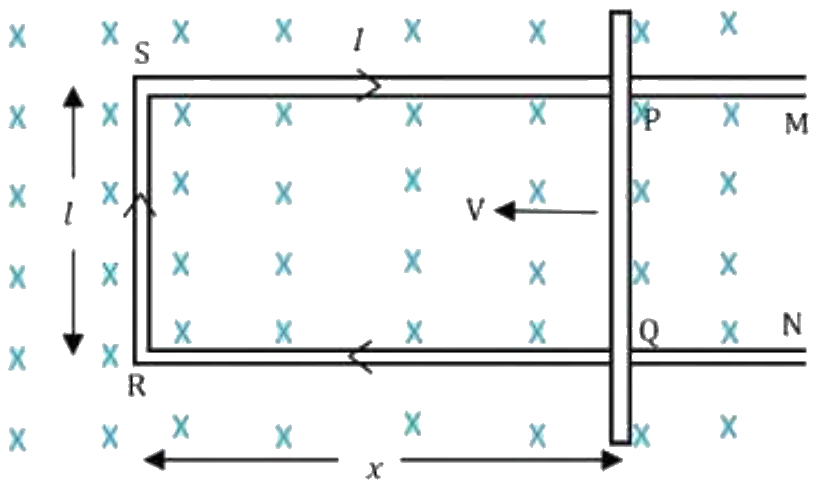
Figure shows a rectangular conductor PQRS in which the conductor PQ is free to move. The conductor PQ is moved towards the left with a constant velocity \( V \) as shown in the figure. Assume that there is no loss of energy due to friction. What will be the magnetic flux linked with the loop PQRS and the motional emf?
Answer & explanation
Correct answer: option 3
The correct answer is Option (3) → Magnetic flux = \( Blx \); Motional emf = \( BlV \)
The field is perpendicular to the loop, so the magnetic flux is the field times the area of the loop. The loop has width \( l \) and length \( x \).
\( \displaystyle \Phi = B \times (l\,x) = Blx \)
By Faraday's law the motional emf is the rate of change of this flux. The rod moves so that \( x \) changes at the rate \( V \), so \( |dx/dt| = V \).
\( \displaystyle \varepsilon = \left| \frac{d\Phi}{dt} \right| = Bl\,\left| \frac{dx}{dt} \right| = BlV \)
Note: This question is from NCERT (2026-27). NTA sets numerical questions from NCERT too, so do not ignore NCERT while practising numericals.
NCERT (2026-27):
Motional Electromotive Force – “… Figure 6.10 shows a rectangular conductor PQRS in which the conductor PQ is free to move. The rod PQ is moved towards the left with a constant velocity v as shown in the figure.
… If the length RQ = x and RS = l, the magnetic flux ΦB enclosed by the loop PQRS will be
\( \displaystyle \Phi_B = Blx \)
Since x is changing with time, the rate of change of flux ΦB will induce an emf given by:
\( \displaystyle \varepsilon = \frac{-\,d\Phi_B}{dt} = -\frac{d}{dt}(Blx) = -Bl\frac{dx}{dt} = Blv \qquad (6.5) \)”