CUETMOCK
  • Pricing
  • Mentors
Log inStart freeStart free mocks→

First test, then trust

Try a free CUET mock test.

Join 5,00,000+ students who rehearsed exam day on the exact NTA screen before sitting CUET. On the web and on Android.

Start free mocks →Get the Android app
CUETMOCK

India's #1 CUET Mock Test Platform. Original NCERT-based questions on the exact NTA exam screen — trusted by 5,00,000+ students since CUET 2022.

Get it onGoogle PlayScan to download the CUETMOCK app

Mock tests

  • CUET mock test series
  • Browse all papers
  • Commerce mocks
  • Humanities (Arts) mocks
  • Science mocks
  • Languages & GAT mocks
  • Free practice questions
  • Pricing

Resources

  • CUET exam guide
  • CUET syllabus
  • Universities accepting CUET
  • Expert blogs
  • News & notifications
  • Webinars & counselling
  • CUET score calculator
  • How we estimate your rank
  • FAQs

Company

  • About us
  • Our leadership & team
  • Our toppers
  • Mentors
  • For schools
  • Contact us
  • Terms
  • Privacy
  • Refund policy

Talk to us

+91 7696 6630 56info@cuetmock.comWhatsApp us

Our other platforms

  • JEE Mock — For IIT-JEE aspirants
  • NEET Mock — For NEET aspirants

Newsletter

Exam updates, study material and offers — no spam.

© 2026 NYC Ventures Pvt. Ltd.

701-702, Royal Business Park, Zirakpur, Punjab - 140603

  • Terms of use
  • Privacy policy
  • Refund policy
  • Contact us

iCUETMOCK is an independent preparation platform, not affiliated with the National Testing Agency (NTA). Always check exam details on the official NTA website.

  • Home
  • Mock tests
  • CUET guide
  • Pricing
  • Log in
Home/Practice questions/Economics
EconomicsMicro Economics: Production and Costs

In the short run, when a fixed input is combined with increasing vari…

In the short run, when a fixed input is combined with increasing variable inputs, the following changes in Average Product (AP) and Marginal Product (MP) are witnessed. Select the correct order of such change starting with the first unit employment of variable input.

A. AP and MP both decrease and AP > MP
B. AP and MP both increase and AP < MP
C. AP intersects MP and after that AP > MP
D. AP = MP, for the first level of output

Choose the correct sequence from the options given below:

Answer & explanation+

Correct answer: option 2

The correct answer is Option (2) → D, B, C, A

Suppose more and more workers are put on a fixed plot of land. The average product (AP) is output per worker, TP/L; the marginal product (MP) is the extra output from one more worker, other inputs held constant. By the law of variable proportions MP first rises and then falls, and AP, being the average of the marginal products, follows it.

D. AP = MP, for the first level of output — for the first unit of the variable input, total product, average product and marginal product are the same number, so AP and MP are equal.

B. AP and MP both increase and AP < MP — as more of the input is used, MP rises. AP, being the average of the marginal products, also rises, but less than MP.

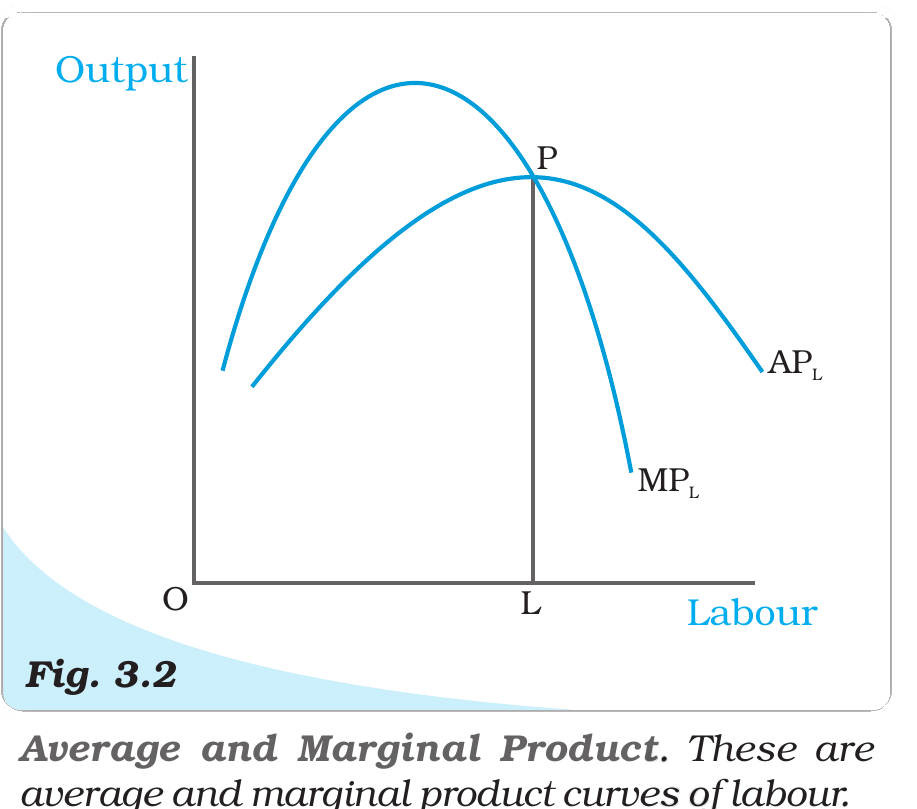
C. AP intersects MP and after that AP > MP — after a point MP starts falling; AP keeps rising as long as MP is above it. When MP has fallen enough, the MP curve cuts the AP curve from above at the maximum of AP, and from there on AP is greater than MP.

A. AP and MP both decrease and AP > MP — beyond that point MP is below AP, so AP falls too; both fall, with AP above MP. Both curves are inverse U-shaped.


NCERT (2025-26): “3.5 Shapes of Total Product, Marginal Product and Average Product Curves … Let us now see what the AP curve looks like. For the first unit of the variable input, one can easily check that the MP and the AP are same. Now as we increase the amount of input, the MP rises. AP being the average of marginal products, also rises, but rises less than MP. Then, after a point, the MP starts falling. However, as long as the value of MP remains higher than the value of the AP, the AP continues to rise. Once MP has fallen sufficiently, its value becomes less than the AP and the AP also starts falling. So AP curve is also inverse ‘U’-shaped.

As long as the AP increases, it must be the case that MP is greater than AP. Otherwise, AP cannot rise. Similarly, when AP falls, MP has to be less than AP. It, follows that MP curve cuts AP curve from above at its maximum.

Figure 3.2 shows the shapes of AP and MP curves for a typical firm. The AP of factor 1 is maximum at L. To the left of L, AP is rising and MP is greater than AP. To the right of L, AP is falling and MP is less than AP.”

NCERT extract

Advertisement

Practise more on Micro Economics: Production and Costs

Chapter-wise mocks on the real NTA exam screen, with solutions and your rank. Your first mocks are free.

Start free mocks →

Advertisement

Next questions

  1. A glass rod is rubbed with a silk cloth. During the rubbing, 2.5×10^10 electrons move from the rod to the silk every second. The rubbing go…Physics · Electric Charges and Fields
  2. Choose the word that is opposite in meaning to the underlined word in the given sentence:The headmaster warned that he would punish any stu…English · Antonyms
  3. The origin of Dalit Panthers in 1972 was formed in state of:Political Science · Politics in India Since Independence: Rise of Popular Movements
  4. Four letter-clusters have been given, out of which three are alike in some manner and one is different. Select the letter-cluster that is d…General Aptitude Test · General Ability
  5. Select the most appropriate synonym of the given word. HAZARDOUSEnglish · Synonyms
  6. A man riding a bike crosses a bridge in 5 minutes when riding at a speed of 15 km/hr. The length of the bridge isGeneral Aptitude Test · Numerical Ability
  7. What is the minimum pH of a solution 0.10 \ M in Mg^2+ from which Mg(OH)_2 will not precipitate? Given: K_sp of Mg(OH)_2 = 1.2 × 10^-11 M^3Chemistry · Equilibrium
  8. Find the general solution of the following differential equation: x dy - (y + 2x^2) dx = 0Maths. Section B1 · Differential Equations
  9. What is the meaning of the idiom "turn a deaf ear"?English · Grammar: Idioms
  10. The probabilities of winning a race by three racers P,Q,R are 1/3,1/4 and 1/5 respectively. The probability of none of them wins in the rac…Maths. Section B1 · Probability