Which of the following is true for the surplus in the Balance of Payments?
Answer & explanation
Correct answer: option 2
The correct answer is Option (2) → Reserve Change < 0
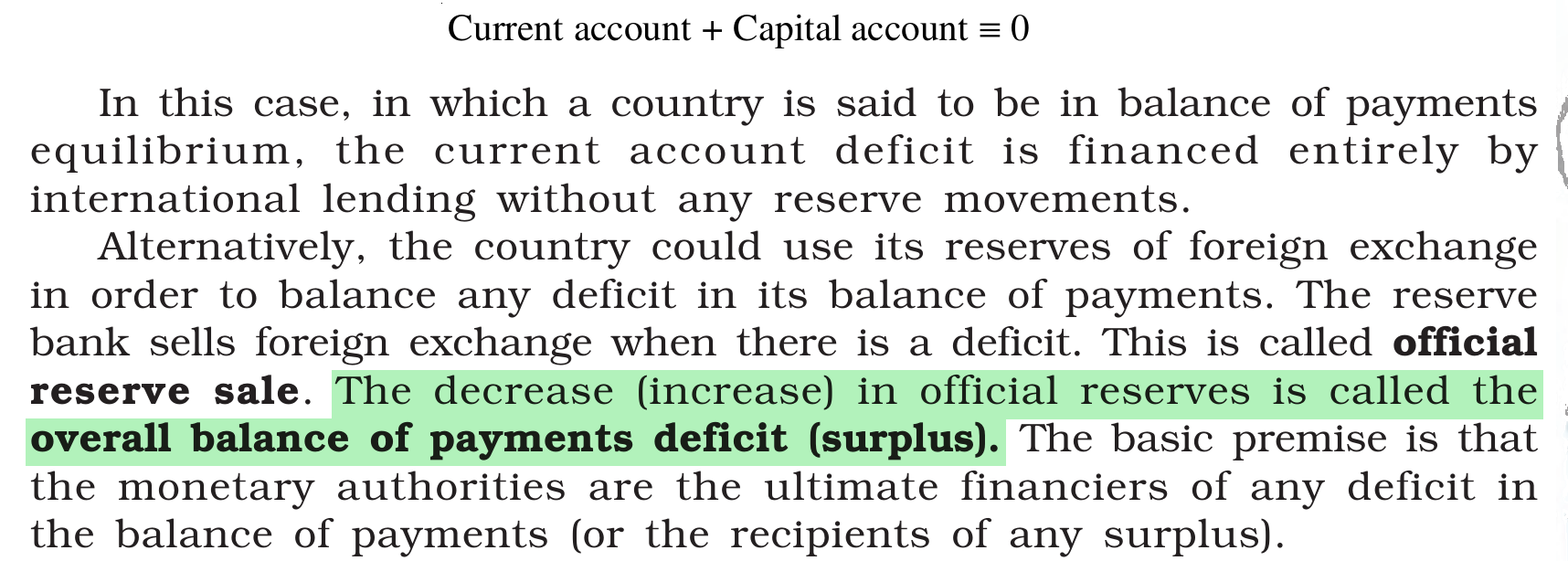
The balance of payments records all the dealings of a country with the rest of the world. Most of them are autonomous transactions, made for their own sake: exports and imports, borrowing and investment. The foreign exchange they bring in and the foreign exchange they send out need not match, and the difference between the two is the overall balance:
BoP surplus: autonomous receipts are greater than autonomous payments, so the overall balance > 0. The extra foreign exchange is added to the central bank’s official reserves.
BoP deficit: autonomous payments are greater, so the overall balance < 0, and the gap is met by drawing on the reserves.
The change in reserves is the accommodating item that makes the accounts balance, so it is entered with the sign opposite to the overall balance. An addition to the reserves is recorded like a purchase of foreign assets, an outflow, with a minus sign. A surplus therefore shows as a reserve change < 0, and a deficit as a reserve change > 0.
Why the other options are incorrect
Option (1) Overall Balance < 0 — Incorrect. A negative overall balance is a BoP deficit.
Option (3) Reserve Change > 0 — Incorrect. This goes with a deficit.
Option (4) Reserve Change = 0 — Incorrect. This is the case of a balanced BoP.
Note: A same/similar question was asked in CUET (UG) in the papers below.
| 2026 | 2025 | 2024 | 2023 | 2022 |
| 11-05 S2 21-05 S2 | – | – | – | – |
NCERT: Introductory Macroeconomics — Chapter 6: Open Economy Macroeconomics (2025-26)
|