Which of the following will not respond to Fehling's Test?
(A) Benzaldehyde
(B) Acetone
(C) Acetaldehyde
(D) Acetophenone
Choose the correct answer from the options given below:
Answer & explanation
Correct answer: option 1
The correct answer is Option (1) → (A), (B) and (D) only
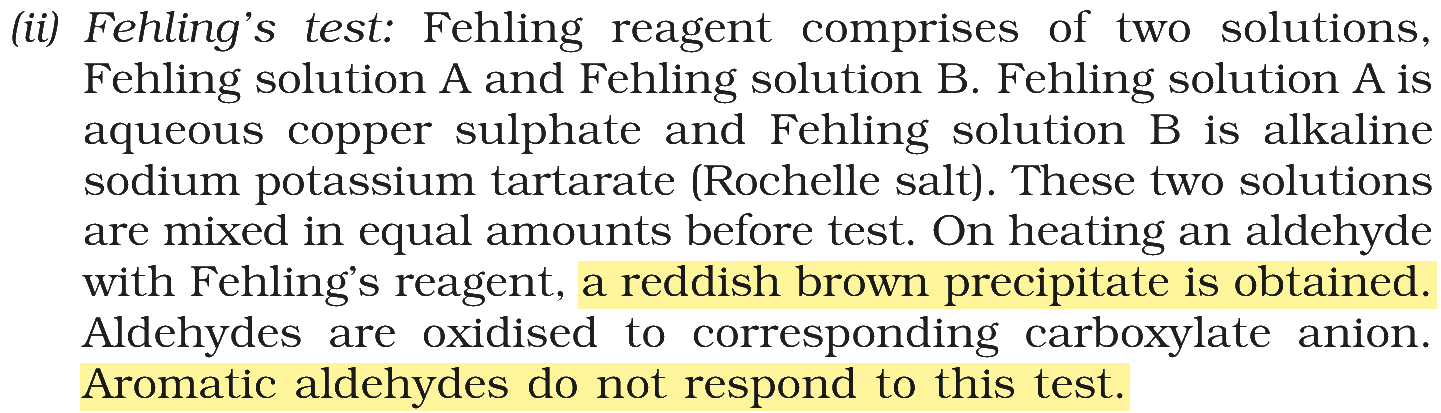
Fehling’s reagent is a mild oxidising agent: Fehling solution A (aqueous copper sulphate) mixed with solution B (alkaline sodium potassium tartrate). On heating, an aldehyde reduces the \( \ce{Cu^2+} \) complex to a reddish brown precipitate of \( \ce{Cu2O} \) and is itself oxidised to the carboxylate ion:
\( \displaystyle \ce{R-CHO + 2Cu^2+ + 5OH^- -> RCOO^- + Cu2O v + 3H2O} \)
Ketones are not oxidised by such a mild reagent, and aromatic aldehydes do not respond to Fehling’s test either.
(A) Benzaldehyde, \( \ce{C6H5CHO} \): an aromatic aldehyde; does not respond.
(B) Acetone, \( \ce{CH3COCH3} \): a ketone; does not respond.
(C) Acetaldehyde, \( \ce{CH3CHO} \): an aliphatic aldehyde; gives the red precipitate.
(D) Acetophenone, \( \ce{C6H5COCH3} \): a ketone; does not respond.
NCERT (2026-27 edition):
Fehling’s Test