
Between $x = 0$ and $x =\frac{π}{2}$ ,let A denote the area enclosed by $y = \sin x, y = \cos x$ and y-axis and $A_2$ denote the area enclosed by $y = \sin x, y = \cos x$ and x-axis. Then,
Answer & explanation
Correct answer: option 1
We find that
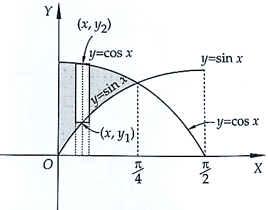
$A_1=\int\limits_{0}^{π/4}(y_2-y_1)dx=\int\limits_{0}^{π/4}(\cos x−\sin x) dx$
$⇒A_1=\left[\sin x+\cos x\right]_{0}^{π/4}=\sqrt{2}-1$
and $A_2=\int\limits_{0}^{π/4}\sin x\, dx+\int\limits_{π/4}^{π/2}\cos x\,dx$
$⇒A_2=[-\cos x]_{0}^{π/4}+[\sin x]_{π/4}^{π/2}$
$⇒A_2=-\frac{1}{\sqrt{2}}+1+1-\frac{1}{\sqrt{2}}=2-\sqrt{2}$
$∴A_1:A_2=(\sqrt{2}-1):\sqrt{2}(\sqrt{2}-1)=1:\sqrt{2}$ and $A_1+A_2=1$