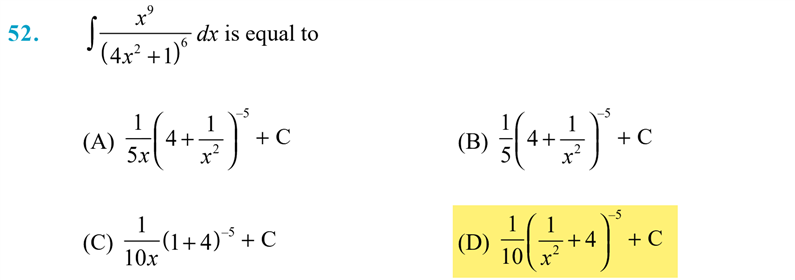
\( \int\displaystyle\frac{x^9}{(4x^2+1)^6}\,dx \) is equal to:
[where \( c \) is an arbitrary constant]
Answer & explanation
Correct answer: option 4
The correct answer is Option (4) → \( \displaystyle\frac{1}{10}\left(\displaystyle\frac{1}{x^2}+4\right)^{-5}+c \)
The denominator has degree 12 and the numerator degree 9. Taking \( x^2 \) out of the bracket makes a function and its derivative appear:
\( \displaystyle (4x^2+1)^6=\left[x^2\left(4+\frac{1}{x^2}\right)\right]^6 \)
\( \displaystyle =x^{12}\left(4+\frac{1}{x^2}\right)^6 \)
\( \displaystyle \int\frac{x^9}{(4x^2+1)^6}\,dx=\int\frac{1}{x^3\left(4+\frac{1}{x^2}\right)^6}\,dx \)
Let \( t=4+\frac{1}{x^2} \) (a substitution). Then
\( \displaystyle dt=-\frac{2}{x^3}\,dx \)
\( \displaystyle \frac{dx}{x^3}=-\frac{dt}{2} \)
\( \displaystyle \int\frac{1}{x^3\left(4+\frac{1}{x^2}\right)^6}\,dx=-\frac{1}{2}\int t^{-6}\,dt \)
\( \displaystyle =-\frac{1}{2}\cdot\frac{t^{-5}}{-5}+c \)
\( \displaystyle =\frac{1}{10}\,t^{-5}+c \)
\( \displaystyle =\frac{1}{10}\left(\frac{1}{x^2}+4\right)^{-5}+c \)
Shortcut: Differentiate Option (4):
\( \displaystyle \frac{d}{dx}\left[\frac{1}{10}\left(x^{-2}+4\right)^{-5}\right]=\frac{1}{10}(-5)\left(x^{-2}+4\right)^{-6}\left(-2x^{-3}\right) \)
\( \displaystyle =\frac{1}{x^3\left(4+\frac{1}{x^2}\right)^6} \)
Multiplying the top and bottom by \( x^{12} \) gives \( \frac{x^9}{(4x^2+1)^6} \), the integrand.
Why the other options are incorrect
Option (1) \( \displaystyle\frac{1}{5x}\left(4+\displaystyle\frac{1}{x^2}\right)^{-5}+c \) — Incorrect. The factor \( \frac{1}{x} \) cannot be taken outside after integrating; its derivative contains extra terms from \( \frac{1}{x} \).
Option (2) \( \displaystyle\frac{1}{5}\left(4+\displaystyle\frac{1}{x^2}\right)^{-5}+c \) — Incorrect. The factor \( \frac{1}{2} \) from \( dt=-\frac{2}{x^3}dx \) has been missed; this is twice the correct answer.
Option (3) \( \displaystyle\frac{1}{10x}(1+4)^{-5}+c \) — Incorrect. The bracket \( (1+4) \) contains no x, so its derivative is \( -\frac{5^{-5}}{10x^2} \), not the integrand.
NCERT Exemplar:
Integrals