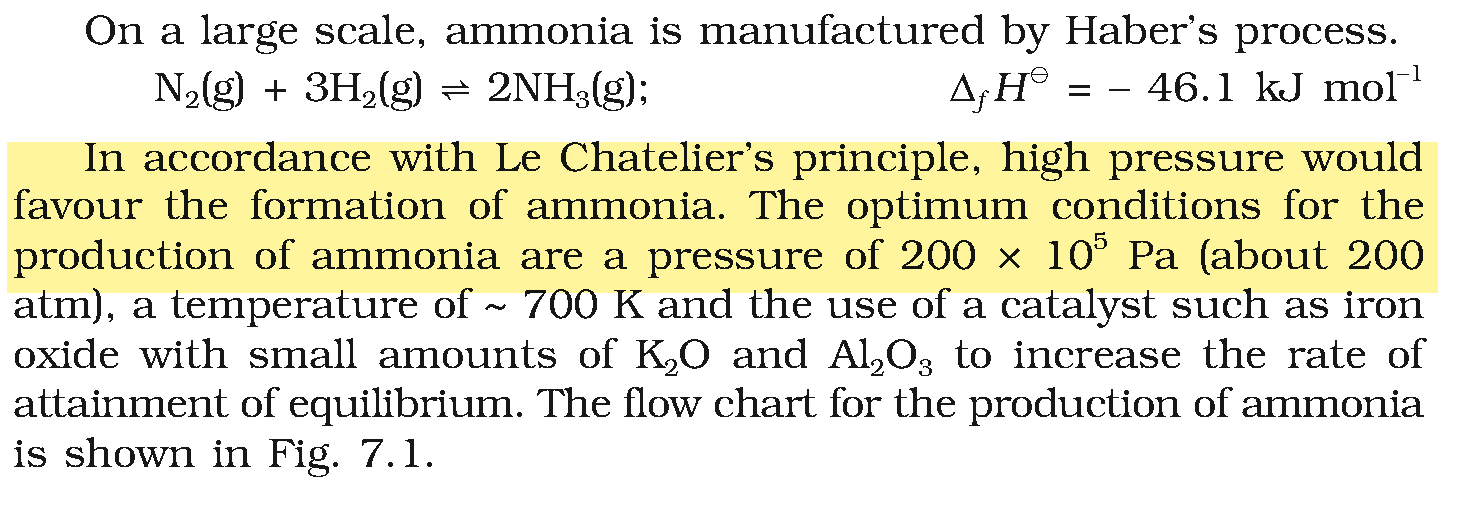
In the reaction
N2(g) + 3H2(g) ⇌ 2NH3(g), ΔfHo = −46.1 kJ mol−1
the yield of ammonia is expected to be maximum at
Answer & explanation
Correct answer: option 3
The correct answer is Option (3) → Low Temperature and High Pressure
\( \ce{N2(g) + 3H2(g) <=> 2NH3(g)} \qquad \Delta_f H^\circ = -46.1\ \mathrm{kJ\,mol^{-1}} \)
Temperature: the forward reaction is exothermic, so by Le Chatelier’s principle a lower temperature shifts the equilibrium towards \( \ce{NH3} \).
Pressure: 4 mol of gas give 2 mol of gas, so a higher pressure favours the side with fewer gas molecules, \( \ce{NH3} \).
In practice about 700 K is used only so that equilibrium is reached at a reasonable rate; the yield itself is greater at lower temperature.
Why the other options are incorrect
Option (1) — Incorrect. High temperature and low pressure both shift the equilibrium back towards \( \ce{N2} \) and \( \ce{H2} \).
Option (2) — Incorrect. High pressure helps, but high temperature lowers the yield of an exothermic reaction.
Option (4) — Incorrect. Low temperature helps, but low pressure favours the side with more gas molecules.
Note: This question is from the pre-rationalised NCERT book (2022-23). The topic is not there in the latest NCERT book (2026-27), and it is also out of the CUET 2026 syllabus.
NCERT (Pre-rationalised edition, 2022-23):
Ammonia – …