
Answer the question on basis of passage given below:
\(G = \frac{\kappa A}{l} = \kappa \) (both\(A\) and \(l\) are unity in their appropriate units in m or cm)
Molar conductivity of a solution at a given concentration is the conductance of the volume \(V\) of solution containing one mole of electrolyte kept between two electrodes with area of cross section \(A\) and distance of unit length \(l\). Therefore,
\(\Lambda_m = \frac{\kappa A}{l}\)
Since \(l = 1\) and \(A = V\) (volume containing 1 mole of electrolyte) \(\Lambda _m =\kappa V\)
Which of the following curve gives the variation of \(\Lambda _m\) with \(\sqrt{c}\) for \(CH_3COOH\).
Answer & explanation
Correct answer: option 4
The correct answer is Option (4) → Λm vs √c curve of a weak electrolyte
Molar conductivity increases on dilution for every electrolyte, but the shape of the Λm vs √c plot depends on the type of electrolyte:
Strong electrolytes (KCl) are fully ionised at all concentrations; Λm rises slowly on dilution and the plot is a straight line, Λm = Λ°m − A√c.
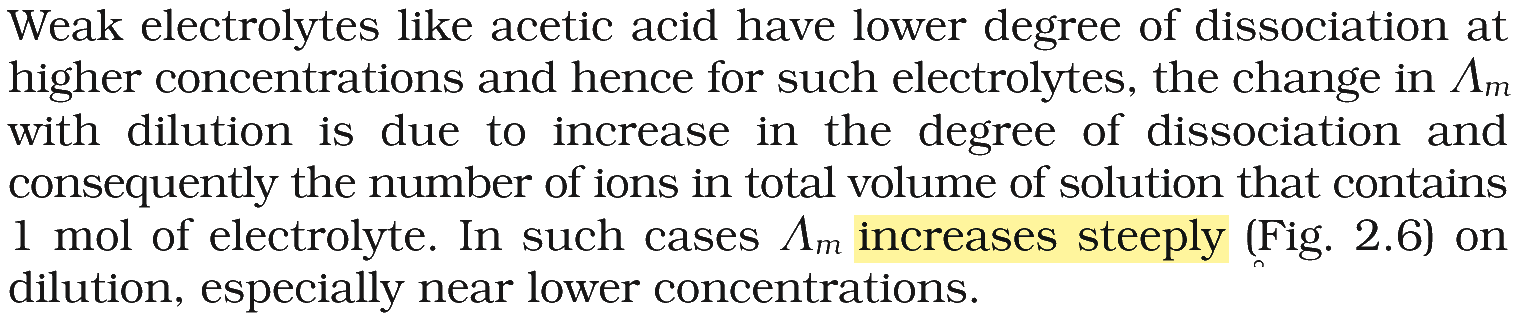
Weak electrolytes (\( \ce{CH3COOH} \)) are only partly ionised. On dilution their degree of dissociation increases, so the number of ions per mole rises and Λm increases steeply near low concentrations. The plot is a curve, high at low √c and falling sharply as √c increases.
Why the other options are incorrect
Option (1) — Incorrect. The axes are interchanged (√c on the y-axis) and the plot is a straight line, the pattern of a strong electrolyte, not of acetic acid.
Option (2) — Incorrect. Λm rises as √c rises, i.e. it would fall on dilution; that is the reverse of the behaviour of every electrolyte.
Option (3) — Incorrect. The axes are interchanged and the line is straight; it shows no steep rise of Λm at low concentration.
NCERT (2026-27 edition):
Weak Electrolytes
Note: The same/similar question has been asked in different years by NTA as per the details given below:
| 2026 | 2025 | 2024 | 2023 | 2022 |
|---|---|---|---|---|
| – | – | – | 01-06 S3 24-05 S3 | – |