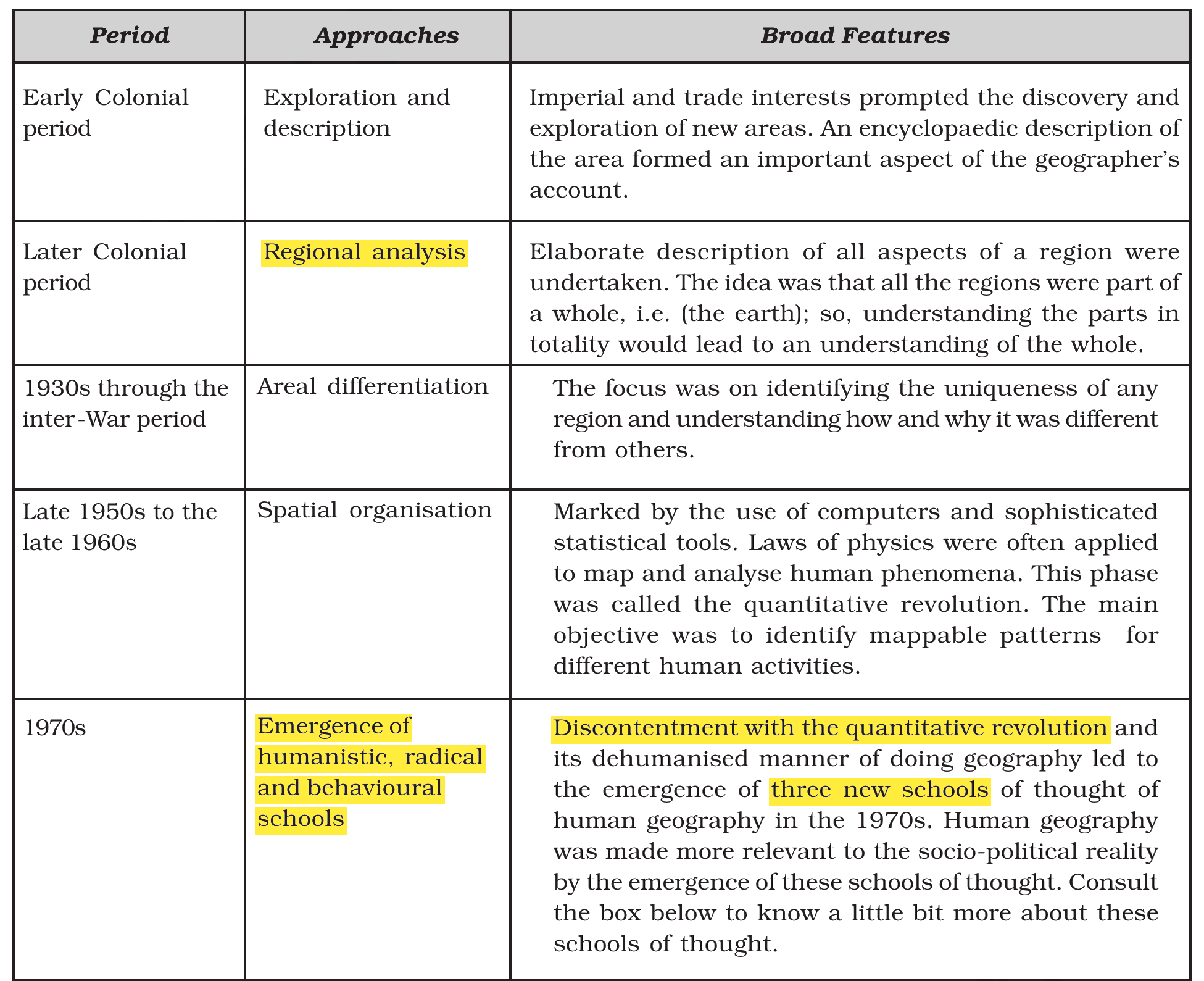
Discontentment with quantitative revolution did not lead to the emergence of ______.
Answer & explanation
Correct answer: option 3
The correct answer is Option (3) → Regional Geography
The quantitative revolution (late 1950s to late 1960s) used computers and statistics to map human activities. In the 1970s, unhappiness with this dehumanised way of doing geography gave rise to three new schools of thought.
Option (1) Humanistic school of geography — Came out of the discontentment. The welfare or humanistic school looked at social well-being, such as housing, health and education.
Option (2) Radical Geography — Came out of the discontentment. The radical school used Marxian theory to explain poverty and social inequality.
Option (3) Regional Geography — Did not come out of the discontentment. Regional analysis was the approach of the later colonial period, long before the quantitative revolution.
Option (4) Behavioural Geography — Came out of the discontentment. The behavioural school stressed lived experience and the perception of space by social groups.
NCERT (2026-27):
Table 1.1: Broad Stages and Thrust of Human Geography (part) |