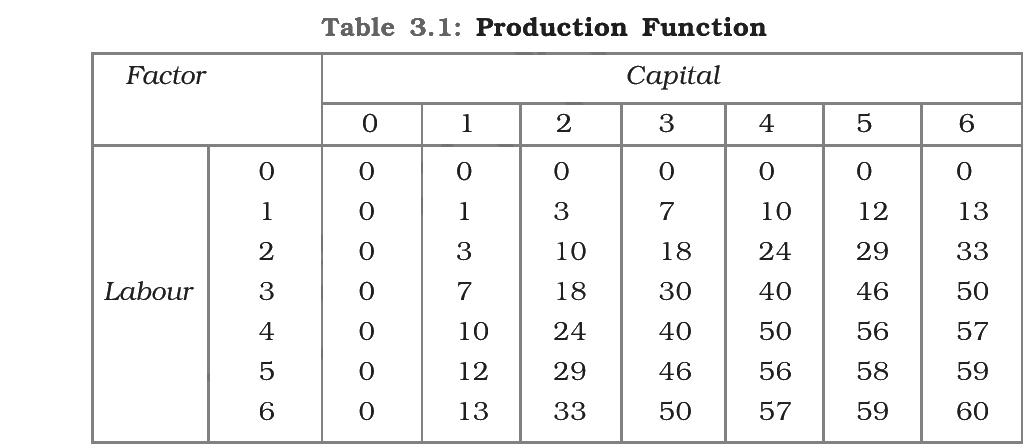
A firm can produce 50 units of output with (L = 6, K = 3), (L = 4, K = 4) or (L = 3, K = 6). The price of a unit of capital is Rs 20. When the price of a unit of labour is Rs 15, the firm chooses one combination. If the price of labour rises to Rs 50, which combination will it choose, and what will be the least cost of 50 units?
Answer & explanation
Correct answer: option 4
The correct answer is Option (4) → It moves from (L = 4, K = 4) to (L = 3, K = 6); the least cost becomes Rs 270
Given:
Price of capital = Rs 20
Price of labour = Rs 15, then Rs 50
Combinations for 50 units: (6, 3), (4, 4), (3, 6)
Cost = price of labour × L + price of capital × K. The firm picks the cheapest combination.
With labour at Rs 15:
\( (6,3): 90 + 60 = 150 \)
\( (4,4): 60 + 80 = 140 \)
\( (3,6): 45 + 120 = 165 \)
With labour at Rs 50:
\( (6,3): 300 + 60 = 360 \)
\( (4,4): 200 + 80 = 280 \)
\( (3,6): 150 + 120 = 270 \)
The firm moves from (L = 4, K = 4) to (L = 3, K = 6), and the least cost is Rs 270. When labour becomes dearer, the firm uses less labour and more capital.
Option (2) It moves from (L = 4, K = 4) to (L = 3, K = 6); the least cost becomes Rs 280 — Rs 280 is the cost of (4, 4) at the new price, not the least cost.
Option (3) It stays at (L = 4, K = 4); the least cost becomes Rs 280 — at the new price, (3, 6) costs less than (4, 4).
NCERT (2026-27): “3.7 Costs In order to produce output, the firm needs to employ inputs. But a given level of output, typically, can be produced in many ways. There can be more than one input combinations with which a firm can produce a desired level of output. In Table 3.1, we can see that 50 units of output can be produced by three different input combinations (L = 6, K = 3), (L = 4, K = 4) and (L = 3, K = 6). The question is which input combination will the firm choose? With the input prices given, it will choose that combination of inputs which is least expensive. So, for every level of output, the firm chooses the least cost input combination. Thus the cost function describes the least cost of producing each level of output given prices of factors of production and technology.”
|