
Potentiometer has multiple uses. It is based on the principle that when constant current flows through a wire of uniform area of cross-section then potential drop along its length is directly proportional to corresponding length.
i.e. \( V \propto l \) ; \( V = K l \)
Various uses of potentiometer on :
- To measure potential differences between any two points in an electrical network
- To compare emf of a cell
- To measure emf of a cell
- To measure internal resistance of a cell etc:
Answer the following question related to potentiometer.
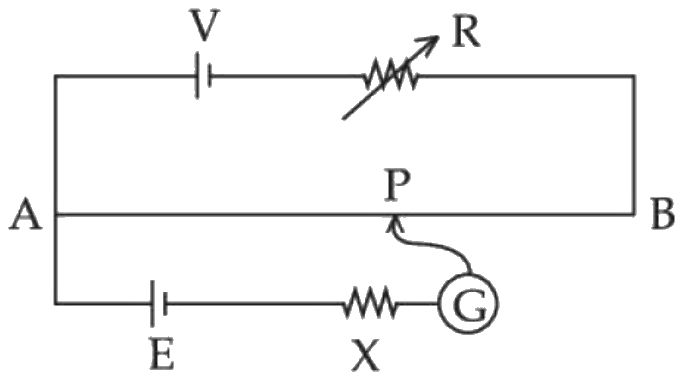
In the given potentiometer the null point for the primary cell is obtained at P. The effect on the balancing length when resistance X is increased, will be :
Answer & explanation
Correct answer: option 2
The correct answer is Option (2) → Balancing length remains unchanged
At the null point the galvanometer shows no deflection, so no current flows in the branch containing the cell E, the resistance X and the galvanometer.
With zero current, there is no potential drop across X:
\( \displaystyle V_{X} = I\,X = 0 \times X = 0 \)
So the potential difference balanced on the wire is just the emf of the cell, and
\( \displaystyle E = k\,l \;\Rightarrow\; l = \frac{E}{k} \)
X appears nowhere in this relation, and the driver circuit (V, R and wire AB), which fixes the potential gradient \( k \), is not changed. Hence the balancing length remains unchanged. A larger X only makes the galvanometer less sensitive near the balance point.
Note: This question is from the pre-rationalised NCERT book (2022-23). The topic was removed from the latest NCERT book (2026-27), and it also appears to be out of the CUET 2026 syllabus.
NCERT (Pre-rationalised edition, 2022-23):
Potentiometer – “… The potentiometer has the advantage that it draws no current from the voltage source being measured. As such it is unaffected by the internal resistance of the source.”