


CUET Preparation Today
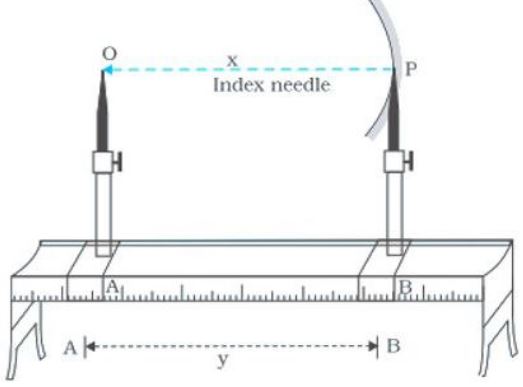
Arrange the following steps (A, B, C and D) in proper sequence to determine the index correction in the given arrangement.
(A) The difference between the two gives the correction to be applied to the observed distance. Choose the correct answer from the options given below: |
(A), (B), (C), (D) (A), (B), (D), (C) (B), (A), (D), (C) (B), (C), (D), (A) |
(B), (C), (D), (A) |
The correct answer is Option (4) → (B), (C), (D), (A) Explanation: (B) First, the observed distance is measured by reading the scale positions of the two uprights. This gives the apparent distance between the pin tip and the mirror pole. (C) Next, a straight index needle is placed such that one end touches the pin tip and the other touches the mirror pole, to get the true physical distance between these points. (D) The actual length of this index needle is then measured on the scale — this represents the true distance between the two points. (A) Finally, the difference between the observed distance (from step B) and the actual distance (from step D) gives the index correction that should be applied to correct the measurement. |