
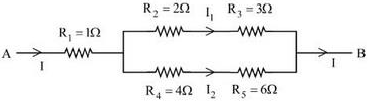
Five resistances are connected as shown in figure. Power dissipated in \( R_1, R_2, R_3, R_4 \) and \( R_5 \) are \( P_1, P_2, P_3, P_4 \) and \( P_5 \) respectively.
Choose the correct answer from the options given below:
Answer & explanation
Correct answer: option 1
The correct answer is Option (1) → \( P_4\lt P_5\lt P_2\lt P_1\lt P_3 \)
The power dissipated in a resistor is \( P = I^{2}R \). From the figure, \( R_1 = 1\,\Omega \) carries the total current I, and the two parallel branches are \( R_2 \) with \( R_3 \) in series (upper) and \( R_4 \) with \( R_5 \) in series (lower).
\( R_{\mathrm{upper}} = 2 + 3 = 5\,\Omega \), \( R_{\mathrm{lower}} = 4 + 6 = 10\,\Omega \)
In parallel the currents divide in the inverse ratio of the resistances, so \( I_1 : I_2 = 10 : 5 = 2 : 1 \).
\( \displaystyle I_1 = \frac{2I}{3}, \qquad I_2 = \frac{I}{3} \)
Power in each resistor (in units of \( I^{2} \) watt, with I in ampere)
\( \displaystyle P_1 = I^{2}\times1 = 1.00\,I^{2} \)
\( \displaystyle P_2 = \left(\frac{2I}{3}\right)^{2}\times2 = \frac{8}{9}I^{2} \approx 0.89\,I^{2} \)
\( \displaystyle P_3 = \left(\frac{2I}{3}\right)^{2}\times3 = \frac{12}{9}I^{2} \approx 1.33\,I^{2} \)
\( \displaystyle P_4 = \left(\frac{I}{3}\right)^{2}\times4 = \frac{4}{9}I^{2} \approx 0.44\,I^{2} \)
\( \displaystyle P_5 = \left(\frac{I}{3}\right)^{2}\times6 = \frac{6}{9}I^{2} \approx 0.67\,I^{2} \)
Arranging in increasing order: \( P_4 \lt P_5 \lt P_2 \lt P_1 \lt P_3 \).