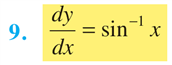
The general solution of the differential equation \(\displaystyle\frac{dy}{dx} = \sin^{-1}x\) is:
Answer & explanation
Correct answer: option 3
The correct answer is Option (3) → \(y = x\sin^{-1}x + \sqrt{1-x^2} + C\), where C is a constant
The variables are already separated, so
\( \displaystyle y = \int \sin^{-1}x \, dx \)
Using integration by parts, with \(\sin^{-1}x\) as the first function and 1 as the second:
\( \displaystyle \int \sin^{-1}x \cdot 1 \, dx = x\sin^{-1}x - \int x\cdot\frac{1}{\sqrt{1-x^2}}\, dx \)
For the last integral put \(t = 1 - x^2\), so \(dt = -2x\,dx\):
\( \displaystyle \int \frac{x}{\sqrt{1-x^2}}\, dx = -\frac{1}{2}\int t^{-\frac{1}{2}}\, dt \)
\( = -\sqrt{t} = -\sqrt{1-x^2} \)
Therefore
\( y = x\sin^{-1}x - \left(-\sqrt{1-x^2}\right) + C \)
\( = x\sin^{-1}x + \sqrt{1-x^2} + C \)
Check: differentiating gives \(\sin^{-1}x + \frac{x}{\sqrt{1-x^2}} - \frac{x}{\sqrt{1-x^2}} = \sin^{-1}x\).
Why the other options are incorrect
Option (1) \(y = x\sin^{-1}x - \sqrt{1-x^2} + C\), where C is a constant — Incorrect. This is the sign slip of subtracting \(\int\frac{x}{\sqrt{1-x^2}}dx\) without its own minus sign; its derivative is \(\sin^{-1}x + \frac{2x}{\sqrt{1-x^2}}\).
Option (2) \(y = x\sin^{-1}x + \sqrt{1+x^2} + C\), where C is a constant — Incorrect. The derivative of \(\sqrt{1+x^2}\) is \(\frac{x}{\sqrt{1+x^2}}\), which does not cancel \(\frac{x}{\sqrt{1-x^2}}\).
Option (4) \(y = -x\sin^{-1}x + \sqrt{1-x^2} + C\), where C is a constant — Incorrect. Its derivative is \(-\sin^{-1}x - \frac{2x}{\sqrt{1-x^2}}\), not \(\sin^{-1}x\).
NCERT (2026-27 edition):
Differential Equations with Variables Separable