
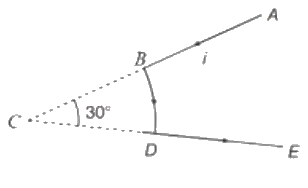
The radius of the arc BD representing a wire is 60 cm. The magnitude of the magnetic field produced at centre C, if a current of 3.0 A flows in the wire, will be
Answer & explanation
Correct answer: option 1
The correct answer is Option (1) → \( \displaystyle\frac{5\pi}{6}\times10^{-7}\,\mathrm{T} \)
The straight wires \( AB \) and \( DE \) lie along lines through the centre \( C \), so by the Biot-Savart law (\( d\vec{l} \times \vec{r} = 0 \) along the line) they produce no field at \( C \). Only the circular arc \( BD \) contributes.
The field at the centre of an arc that subtends an angle \( \theta \) is a fraction \( \theta/2\pi \) of the field of a full circle.
\( \displaystyle B = \frac{\mu_{0}I}{2r} \times \frac{\theta}{2\pi} = \frac{\mu_{0}I\,\theta}{4\pi r} \)
\( \theta = 30^\circ = \pi/6\,\mathrm{rad} \)
\( r = 60\,\mathrm{cm} = 0.6\,\mathrm{m} \)
\( I = 3.0\,\mathrm{A} \)
\( \displaystyle B = 10^{-7} \times \frac{3.0 \times (\pi/6)}{0.6} = \frac{5\pi}{6}\times10^{-7}\,\mathrm{T} \)