CUETMOCK
  • Pricing
  • Mentors
Log inStart freeStart free mocks→

First test, then trust

Try a free CUET mock test.

Join 5,00,000+ students who rehearsed exam day on the exact NTA screen before sitting CUET. On the web and on Android.

Start free mocks →Get the Android app
CUETMOCK

India's #1 CUET Mock Test Platform. Original NCERT-based questions on the exact NTA exam screen — trusted by 5,00,000+ students since CUET 2022.

Get it onGoogle PlayScan to download the CUETMOCK app

Mock tests

  • CUET mock test series
  • Commerce mocks
  • Humanities (Arts) mocks
  • Science mocks
  • Languages & GAT mocks
  • Free practice questions
  • Pricing

Resources

  • CUET exam guide
  • CUET syllabus
  • Universities accepting CUET
  • Expert blogs
  • News & notifications
  • Webinars & counselling
  • CUET score calculator
  • How we estimate your rank
  • FAQs

Company

  • About us
  • Our leadership & team
  • Our toppers
  • Mentors
  • For schools
  • Contact us
  • Terms
  • Privacy
  • Refund policy

Talk to us

+91 7696 6630 56info@cuetmock.comWhatsApp us

Our other platforms

  • JEE Mock — For IIT-JEE aspirants
  • NEET Mock — For NEET aspirants

Newsletter

Exam updates, study material and offers — no spam.

© 2026 NYC Ventures Pvt. Ltd.

701-702, Royal Business Park, Zirakpur, Punjab - 140603

  • Terms of use
  • Privacy policy
  • Refund policy
  • Contact us

iCUETMOCK is an independent preparation platform, not affiliated with the National Testing Agency (NTA). Always check exam details on the official NTA website.

  • Home
  • Mock tests
  • CUET guide
  • Pricing
  • Log in
Home/Practice questions/Economics
EconomicsMicro Economics: Theory of Consumer behaviour

What will be elasticity of demand of a commodity when its price rises…

What will be elasticity of demand of a commodity when its price rises by 20% and quantity demanded falls from 125 units to 75 units?

Answer & explanation+

Correct answer: option 3

The correct answer is Option (3) → \( e_D=2 \)

Given:

Rise in price = 20 per cent

Initial quantity = 125 units

New quantity = 75 units

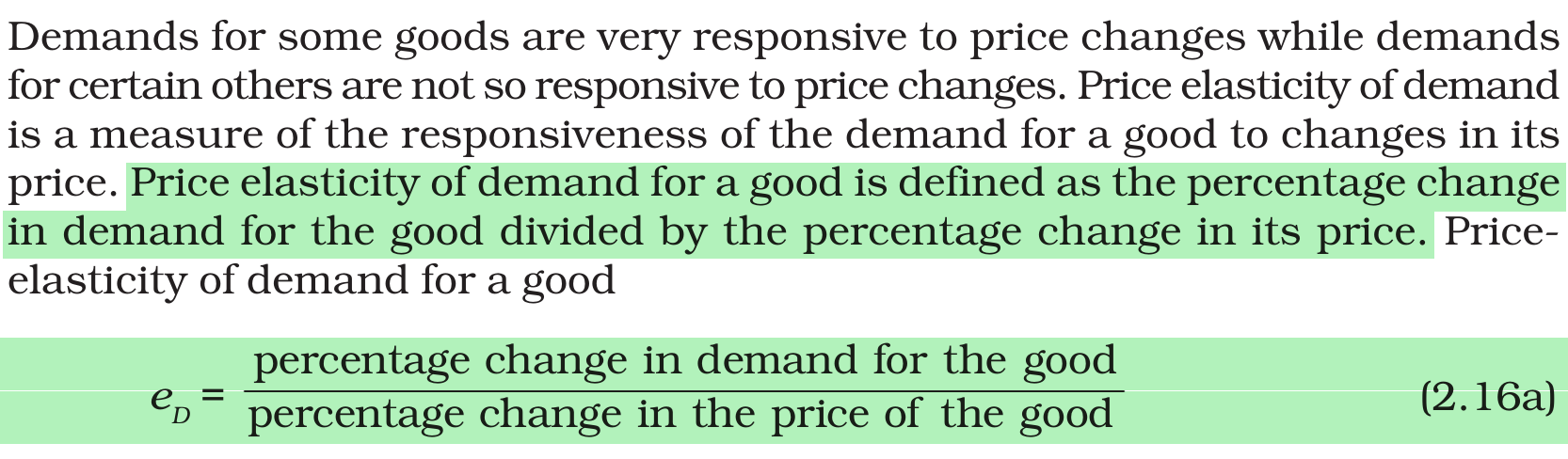
Price elasticity of demand (eD) is the percentage change in quantity demanded divided by the percentage change in price:

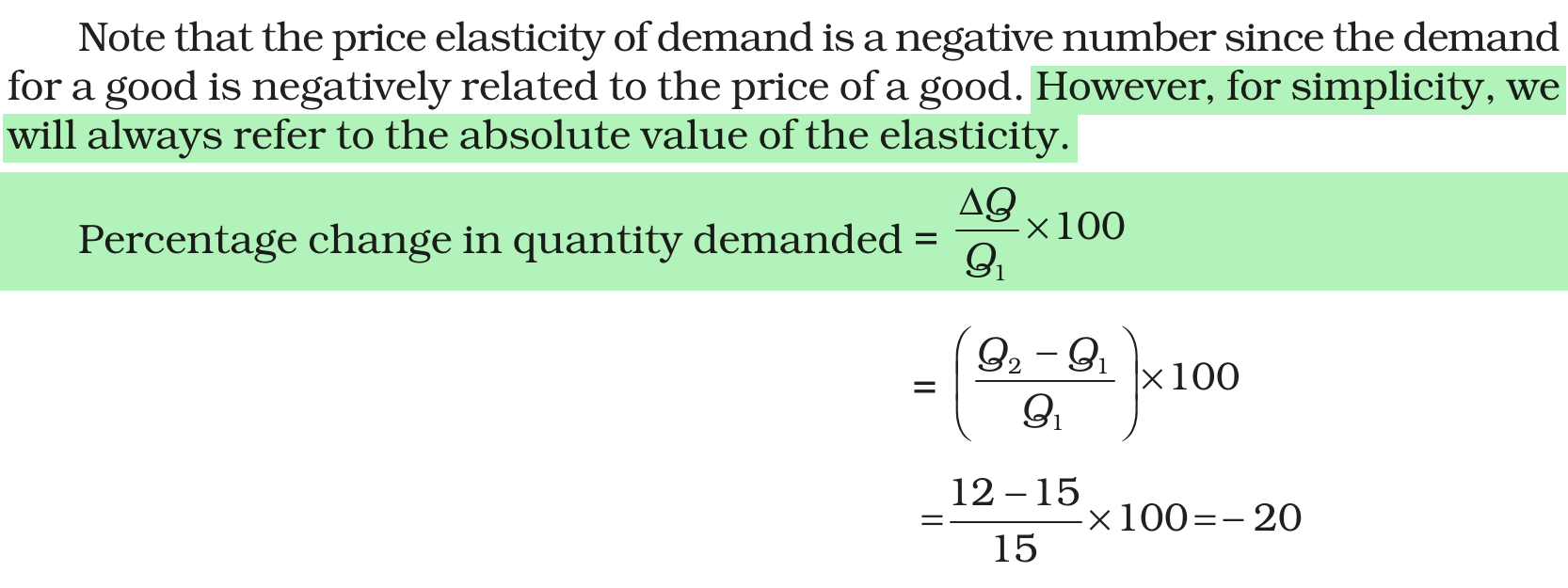
Percentage change in quantity = \( \displaystyle \frac{75 - 125}{125} \times 100 \) = −40 per cent

eD = 40 ÷ 20 = 2 (the minus sign is dropped)

NCERT (2026-27): Introductory Microeconomics — Chapter 2: Theory of Consumer Behaviour

NCERT extract

NCERT extract

Advertisement

Practise more on Micro Economics: Theory of Consumer behaviour

Chapter-wise mocks on the real NTA exam screen, with solutions and your rank. Your first mocks are free.

Start free mocks →

Advertisement

Next questions

  1. Select the Venn diagram that best illustrates the relationship between the following classes. Fathers, Males, BrothersGeneral Aptitude Test · Verbal Reasoning
  2. Which of the following is NOT a principal centre of the Revolt of 1857?History · Modern India: Rebels and the Raj
  3. Select the option that is related to the fifth term in the same way as the second term is related to the first term and the fourth term is…General Aptitude Test · General Ability
  4. Who is the first classical dancer of foreign origin who was conferred the Padma Shri in 2006 for her contributions to Odissi?General Aptitude Test · General Knowledge
  5. Study the following graph and answer the question based on the graph. On which day the production was 20% of the total production?General Aptitude Test · Quantitative Reasoning
  6. "Soft drink bottles are sealed under high pressure to increase the solubility of carbon dioxide" is the application of which of the followi…Chemistry · Physical: Solutions
  7. Select the option figure in which the given figure is embedded. (rotation is NOT allowed)General Aptitude Test · Verbal Reasoning
  8. Which of the following statements is correct in reference to the Human Development Report 2016 of the United Nations Development Programme?…Political Science · Contemporary World Politics: Environment and Natural Resources
  9. Seller has no control over its product’s price. Which market structure can it possibly belong to?Economics · Micro Economics: Non Competitive markets
  10. Assertion (A): The enactment of the FRBMA in August 2003 marked a turning point in fiscal reforms in India.Reason (R): It bound the governm…Economics · Macro Economics: Government Budget and Economy