Match List-I with List-II :
| List-I | List-II | ||
| (A) | Self employment programme | (I) | Rural Employment Generation Programme |
| (B) | Swarna Jayanti Shahari Rozgar Yojana | (II) | Aim to promote thrift in small proportion |
| (C) | Self help groups | (III) | Wage employment to every rural adult household volunteer to do unskilled manual work |
| (D) | Mahatma Gandhi National Rural Employment Guarantee Act | (IV) | Its aim is to create both self employment and wage employment |
Choose the correct answer from the options given below :
Answer & explanation
Correct answer: option 1
The correct answer is Option (1) → (A)-(I), (B)-(IV), (C)-(II),(D)-(III)
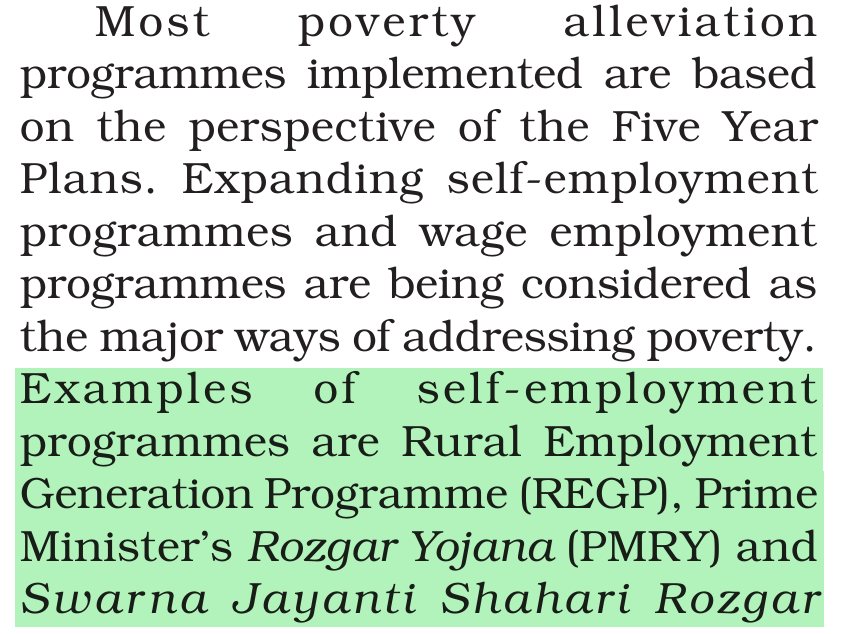
The government fights poverty in two main ways. Self-employment programmes help people start their own small work. Wage employment programmes give them paid work on public projects.
| List-I | List-II | Reason |
|---|---|---|
| (A) Self employment programme | (I) Rural Employment Generation Programme | Under this programme, people got bank loans to set up small industries. So it is a self-employment programme. |
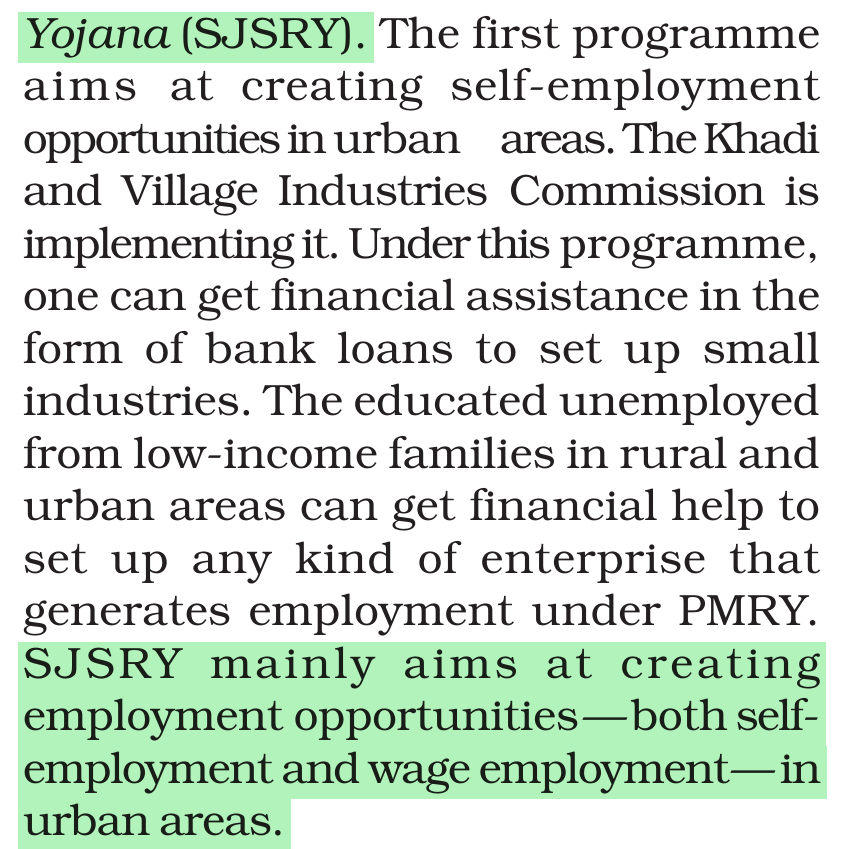
| (B) Swarna Jayanti Shahari Rozgar Yojana | (IV) Its aim is to create both self employment and wage employment | ‘Shahari’ means urban. This scheme was for the urban poor and created both self-employment and wage employment in towns. |
| (C) Self help groups | (II) Aim to promote thrift in small proportion | Each member puts in a small sum, so the group promotes thrift (saving). Loans are then given to needy members from the pooled money. |
| (D) Mahatma Gandhi National Rural Employment Guarantee Act | (III) Wage employment to every rural adult household volunteer to do unskilled manual work | The Act promises 100 days of wage employment in a year to rural households who volunteer to do unskilled manual work. |
Note 1: This question is taken from the chapter ‘Poverty’ which was there in the pre-rationalised NCERT and has been deleted from subsequent editions of NCERT, including the NCERT book (2026-27). The chapter was also not in the CUET (UG) 2026 syllabus.
Note 2: The 2018-19 print of the pre-rationalised NCERT names the Rural Employment Generation Programme as a self-employment programme. The Khadi and Village Industries Commission ran it. The NCERT prints from 2021-22 onwards, including the NCERT book (2026-27), do not name it.
NCERT (2026-27): “5.3 Credit and Marketing in Rural Areas … Recently, Self-Help Groups (henceforth SHGs) have emerged to fill the gap in the formal credit system because the formal credit delivery mechanism has not only proven inadequate but has also not been fully integrated into the overall rural social and community development. Since some kind of collateral is required, vast proportion of poor rural households were automatically out of the credit network. The SHGs promote thrift in small proportions by a minimum contribution from each member. From the pooled money, credit is given to the needy members to be repayable in small instalments at reasonable interest rates.…” NCERT (2026-27), chapter ‘Employment: Growth, Informalisation and Other Issues’: “6.9 Government and Employment Generation You may recall about the Mahatma Gandhi National Rural Employment Guarantee Act 2005. It promises 100 days of guaranteed wage employment to all rural households who volunteer to do unskilled manual work. The scheme based on this Act is one of the many measures the government has implemented to generate employment for those who are in need of jobs in rural areas.…”
|