


CUET Preparation Today
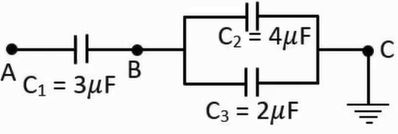
In the given circuit, if the potential at A is 50 V, then potential at B is:
|
$\frac{50}{3}V$ $\frac{100}{3}V$ 50 V 25 V |
$\frac{50}{3}V$ |
The correct answer is Option (1) → $\frac{50}{3}V$ Solution: Given: Potential at A = $50\ \text{V}$ The capacitors $C_2$ and $C_3$ are connected in parallel, so their equivalent capacitance is: $C_{23} = C_2 + C_3 = 4 + 2 = 6\ \mu\text{F}$ Now, $C_1$ ($3\ \mu\text{F}$) is in series with $C_{23}$ ($6\ \mu\text{F}$). For capacitors in series, the charge $Q$ on each is the same, and total voltage is given by: $50 = \frac{Q}{C_1} + \frac{Q}{C_{23}}$ Substitute the values: $50 = Q\left(\frac{1}{3} + \frac{1}{6}\right)$ Therefore, $50 = Q \cdot \frac{1}{2}$ $\Rightarrow Q = 100\ \mu\text{C}$ The potential at point B is the voltage across $C_{23}$: $V_B = \frac{Q}{C_{23}} = \frac{100}{6} = \frac{50}{3}\ \text{V}$ Hence, the potential at B is: $V_B = \frac{50}{3}\ \text{V} \approx 16.67\ \text{V}$ |