Read the passage and answer the question:
The British element is gone, but they have left the mischief behind. We do not want to perpetuate that mischief. (Hear, hear). When the British introduced this element they had not expected that they will have to go so soon. They wanted it for their easy administration. That is all right. But they have left the legacy behind. Are we to get out of it or not?
Identify the incorrect statement related to Pocker Bahadur in the context of the minorities.
A. He felt that there was a need to create a framework in which minorities could live in harmony.
B. He believed that the separate electorates would minimize differences between communities.
C. He believed that the minorities should be represented in the political system.
D. Pocker Bahadur made a powerful plea for discontinuing separate electorates.
Choose the correct answer from the options given below:
Answer & explanation
Correct answer: option 4
The correct answer is Option (4) → D only
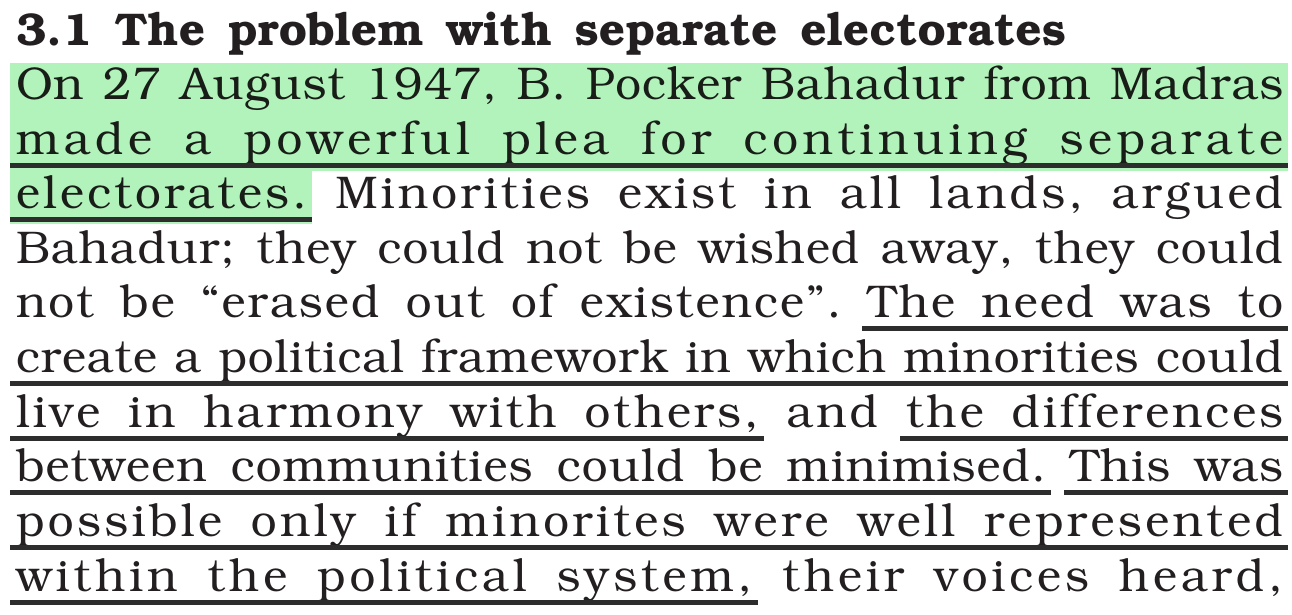
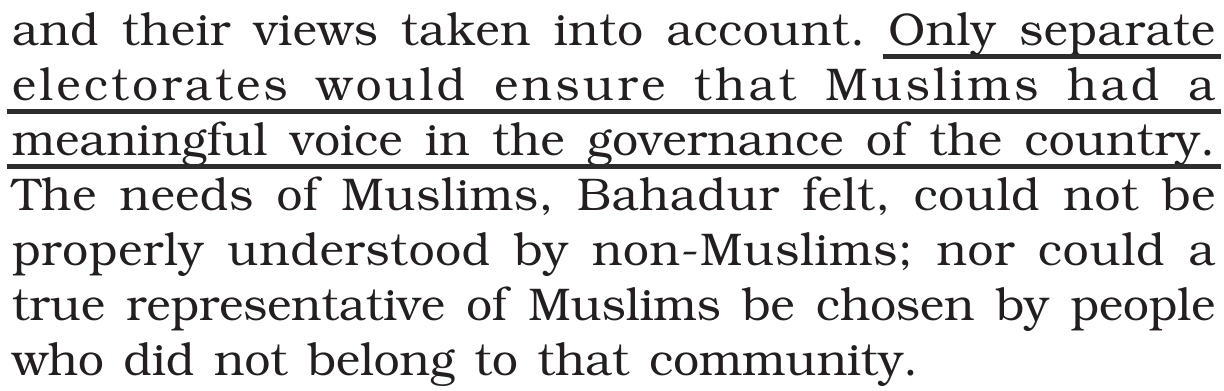
A. He felt that there was a need to create a framework in which minorities could live in harmony. Correct statement. Minorities exist in all lands, argued Bahadur; the need was to create a political framework in which minorities could live in harmony with others.
B. He believed that the separate electorates would minimize differences between communities. Correct statement. In such a framework, he said, the differences between communities could be minimised, and only separate electorates would ensure that Muslims had a meaningful voice in the governance of the country.
C. He believed that the minorities should be represented in the political system. Correct statement. This was possible only if minorities were well represented within the political system, their voices heard and their views taken into account.
D. Pocker Bahadur made a powerful plea for discontinuing separate electorates. Incorrect statement. It was the opposite. On 27 August 1947, B. Pocker Bahadur from Madras made a powerful plea for continuing separate electorates.
NCERT: Themes in Indian History Part III — Chapter 12: Framing the Constitution (2026-27)
|