Which of the following amines does not undergo carbylamine reaction?
Answer & explanation
Correct answer: option 3
The correct answer is Option (3) → N-methylethanamine
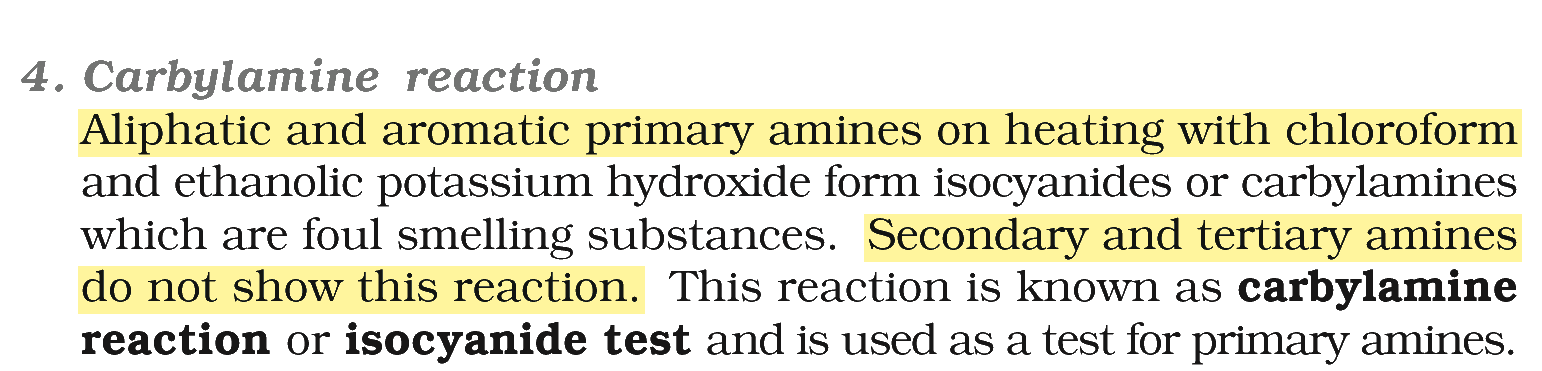
In the carbylamine reaction (isocyanide test), a primary amine is warmed with chloroform and ethanolic KOH. It forms an isocyanide, which has a very unpleasant smell:
\( \displaystyle \ce{R-NH2 + CHCl3 + 3KOH} \xrightarrow{\text{heat}} \ce{R-NC + 3KCl + 3H2O} \)
The nitrogen must lose both of its hydrogen atoms to form R–N≡C. Secondary amines (one N–H) and tertiary amines (no N–H) cannot do this, so they do not give the test.
The four amines are:
Option 1: \( \ce{C6H5NH2} \), aniline (primary, aromatic)
Option 2: \( \ce{CH3-CH(NH2)-CH3} \), propan-2-amine (primary)
Option 3: \( \ce{CH3-NH-CH2-CH3} \), N-methylethanamine (secondary)
Option 4: \( \ce{CH3-CH2-CH2-NH2} \), propan-1-amine (primary)
Option (1) aniline — Undergoes carbylamine reaction (primary amine). It gives phenyl isocyanide, \( \ce{C6H5NC} \).
Option (2) propan-2-amine — Undergoes carbylamine reaction (primary amine). Its –\( \ce{NH2} \) sits on a secondary carbon, but the class of an amine depends on the groups on nitrogen, not on carbon.
Option (3) N-methylethanamine — Does not undergo carbylamine reaction (secondary amine). It has only one N–H hydrogen, so it cannot form R–N≡C.
Option (4) propan-1-amine — Undergoes carbylamine reaction (primary amine). It gives propyl isocyanide.
NCERT (2026-27 edition):
Carbylamine Reaction